
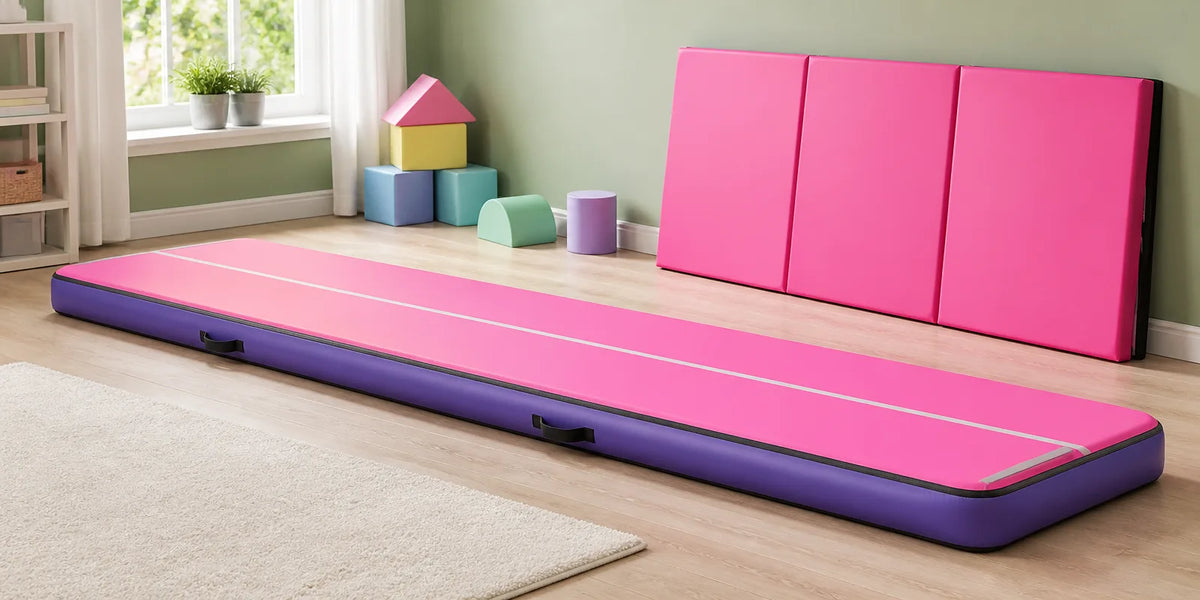
An air tumbling mat is an inflatable training surface built for gymnastics, cheer, acrobatics, fitness drills, and active play. Unlike a standard foam mat, it uses air pressure and drop stitch construction to create adjustable firmness, responsive rebound, and easier portability, which makes it a practical choice for beginners, families, and athletes who want a safer place to practice at home.
Key Takeaways
- An air tumbling mat is an inflatable practice surface designed for tumbling, gymnastics, cheerleading, stretching, and low-impact training.
- Its drop-stitch construction helps the mat stay flat, stable, and supportive while delivering a more responsive bounce than most foam mats.
- Air pressure changes how the mat feels, so users can make it softer for beginner practice or firmer for higher rebound and stronger feedback.
- These mats are popular for home use because they are portable, easy to store, and suitable for indoor or outdoor training in the right conditions.
- The best air tumbling mat depends on skill level, training goal, available space, thickness, surface setup, and overall build quality.
Introduction
Air tumbling mats have become one of the most popular home training tools for gymnastics and active play because they combine safety, rebound, and convenience in one portable surface. Whether you are helping a child build confidence, practicing cheer skills, or creating a more forgiving area for stretching and movement drills, understanding how an air mat works will help you choose the right setup and use it more effectively.
What Is an Air Tumbling Mat?
At its simplest, an air tumbling mat is an inflatable mat made for movement practice that involves jumping, landing, balancing, rolling, and tumbling. It is usually rectangular, made from durable airtight materials, and designed to provide more energy return and adjustable support than a traditional foam exercise mat.
What makes it different is the combination of portability and performance. A quality air mat can be inflated for use, deflated for storage, and adjusted to match the user’s skill level, which makes it useful for children, beginners, teens, adults, and even more advanced athletes working on controlled progressions.
How Does an Air Tumbling Mat Work?
The performance of an air tumbling mat comes from its internal construction and air pressure. Most high-quality mats use drop-stitch technology, which means thousands of internal threads connect the top and bottom layers so the mat stays flat and holds its shape when inflated.
This construction creates a training surface that feels stable underfoot while still offering bounce and cushioning. Instead of collapsing like a soft inflatable toy, the mat distributes pressure more evenly and gives users a firmer, more predictable landing surface.
Air pressure also changes how the mat performs. Lower pressure usually creates a softer feel with more cushioning, while higher pressure creates a firmer surface with stronger rebound and more immediate landing feedback.
That adjustability is one of the biggest reasons air mats are so popular. Beginners often prefer a slightly softer setup for confidence and impact reduction, while experienced users may want a firmer feel for better control during handsprings, roundoffs, and connected tumbling drills.
Common Uses and Users
Air tumbling mats are used by a wide range of people because they support both skill practice and general movement. They work well for structured training, casual recreation, and home fitness routines.
Gymnastics and Cheerleading
Gymnasts and cheer athletes often use air mats for skills such as cartwheels, walkovers, handsprings, roundoffs, aerial drills, jumps, and standing tumbling. The surface offers a more forgiving landing area than a hard floor while still providing enough response to practice technique and timing.
Dance, Parkour, and Tricking
Air mats are also useful for tricking, freerunning basics, dance transitions, and body control drills. They give users a safer place to rehearse takeoffs, rolls, directional changes, and movement combinations with less impact stress than a hard training surface.
Multi-Purpose Fitness and Wellness
Adults often use air tumbling mats for stretching, yoga, balance work, mobility training, and low-impact conditioning. The cushioned surface can feel more comfortable on the wrists, knees, ankles, and hips than tile, wood, or concrete-based flooring.
Home and Recreational Play
Families often choose air mattresses for active play because they create a softer, more controlled environment for jumping games, obstacle courses, and basic movement practice. Many models are also waterproof, which makes them useful for backyard setups and some water-based recreation when used as intended by the manufacturer.
Key Features and Components
Several design details separate a true air tumbling mat from a generic inflatable pad. These features affect durability, safety, stability, and overall training feel.
- Drop Stitch Core: The drop stitch core is what gives the mat its flat profile and supportive structure. It helps the mat stay evenly inflated and improves consistency across the full surface.
- Durable Outer Material: Most quality air mats use heavy-duty PVC or similar airtight material designed to resist wear, repeated landings, and outdoor exposure. Better materials also improve seam durability and air retention over time.
- Adjustable Firmness: Inflation level changes the mat’s feel, which allows one product to serve different users and training stages. This is especially useful in households where children and adults may share the same mat.
- Non-Slip Surface: A textured or anti-slip surface helps improve footing during drills, landings, and transitions. This becomes especially important when the mat is used for gymnastics skills that require straight approach lines and controlled takeoffs.
- Valve and Pump System: A high-pressure valve and compatible pump make inflation and deflation faster and more practical. A reliable pump system also helps users fine-tune firmness instead of settling for a one-feel setup.
- Portability Accessories: Many mats include a carrying bag and repair kit for easier transport and maintenance. These extras matter more than they seem because home users often move the mat between rooms, garages, yards, and storage spaces.
Benefits of Using an Air Tumbling Mat
The biggest advantage of an air tumbling mat is that it combines impact absorption with useful rebound. That balance makes it more versatile than many other practice surfaces.
Safety and Impact Absorption
An air mat helps reduce landing stress by cushioning impact more effectively than a hard floor does. While it does not eliminate injury risk, it can lower joint strain and create a more forgiving environment for drills, beginner progressions, and repeated practice.
Performance and Skill Progression
A responsive mat can help users build confidence as they learn technique, timing, and body awareness. For many athletes, that means a smoother path from basic movements to more advanced tumbling patterns.
Portability and Easy Storage
One of the strongest benefits for home users is portability. Air mats can be deflated, packed away, moved between training areas, and stored more easily than large foam blocks or permanent flooring systems.
Versatility Across Activities
A good air mat supports more than one type of workout. It can be used for gymnastics, cheer, stretching, yoga, balance drills, active play, movement education, and some light conditioning work, which increases its value for families and multi-use spaces.
How to Choose the Right Air Tumbling Mat
The right air tumbling mat depends on who will use it, what skills will be practiced, and where the mat will be placed. Choosing by price alone often leads to the wrong size, the wrong firmness, or a mat that does not fit the training space.
Intended Use and Skill Level
Start by identifying the main use case. A mat for a young child doing beginner movement drills does not need the same size or feel as a mat for a teen practicing connected tumbling passes.
If the main goal is home play and beginner confidence, a softer and more forgiving setup usually makes sense. If the goal is more serious gymnastics or cheer practice, users often need a longer mat, better stability, and more precise pressure control.
Size and Dimensions
Longer mats are better for running entries, connected skills, and tumbling combinations. Shorter mats are often enough for standing skills, stretching, balance work, preschool movement, or compact home use.
It is also important to measure the full practice area, not just the mat itself. Users need safe clearance around the edges for approach steps, landings, and unexpected movement.
Thickness and Feel
Thickness affects both cushioning and training response. A mat that feels too soft may reduce stability, while a mat that feels too firm may not provide enough comfort for beginners.
The best setup is usually the one that matches the athlete’s current stage rather than the most aggressive rebound possible. For many users, control and confidence matter more than maximum bounce.
Quality and Safety Standards
Look closely at material quality, seam construction, valve reliability, and real product details rather than vague marketing language. A better built mat usually lasts longer, holds air more consistently, and performs more predictably during repeated landings.
Indoor and Outdoor Environment
Think about where the mat will be used most often. Indoor users should check ceiling height, floor grip, nearby furniture, and available run-up space, while outdoor users should think about debris, moisture, direct sun exposure, and surface cleanliness.
Setup, Use, and Safety Tips
A quality mat performs best when it is set up correctly and used within appropriate skill limits. Good equipment helps, but safe surroundings and realistic progressions matter just as much.
Proper Setup
Place the mat on a flat, clean surface free from sharp objects, dirt, and uneven ground. Before training, check that the surrounding area has enough open space for entries, exits, and safe landings.
Inflate the mat gradually and test the firmness before starting. The goal is a stable, supportive surface that matches the user’s weight, skill level, and type of practice.
Safe Use
Use the mat for skills that match the user’s current ability. Even though air mats reduce impact, advanced flips and high-risk tumbling still require proper instruction, spotting when appropriate, and careful progression.
Children should be supervised during active use. A softer surface can improve confidence, but it should never replace common sense, coaching, or basic safety rules.
Care and Maintenance
Keep the mat clean and dry before storing it. Regularly inspect the surface, seams, and valve area so small problems can be handled before they affect performance.
Store the mat away from prolonged heat and rough conditions when not in use. If a puncture happens, use the repair kit according to the manufacturer’s instructions and avoid heavy use until the patch is secure.
Air Tumbling Mat vs. Other Tumbling Surfaces
An air tumbling mat sits between a foam mat and a spring floor in both feel and function. That middle ground is exactly why it works so well for home use.
Air Tumbling Mat vs. Foam Mat
Foam mats provide cushioning, but they usually do not offer much rebound. Air mats generally feel more energetic and adjustable, which makes them more useful for movement practice that depends on takeoff and landing rhythm.
Air Tumbling Mat vs. Spring Floor
A spring floor delivers stronger and more consistent bounce, but it is expensive, stationary, and not realistic for most homes. An air mat does not fully replace a competition or gym floor, yet it gives home users a practical training surface with much better portability.
Air Tumbling Mat vs. Grass
Grass is convenient, but it is uneven and unpredictable. An air mat placed on a suitable surface creates a more controlled and joint-friendly setup than practicing directly on the ground.
FAQs
Is an air tumbling mat safe for beginners and kids?
Yes, air tumbling mats are often beginner-friendly because they offer cushioning and adjustable firmness. They are still best used with supervision, age-appropriate drills, and realistic skill progressions.
How long does it take to inflate and deflate?
Most air tumbling mats can be inflated and deflated within a few minutes when used with the correct pump. Exact time depends on the size of the mat and the pump’s power.
Can it be used in water or on grass?
Many air mats are waterproof and can be used outdoors, including on grass, if the area is clean and free from sharp objects. Some models are also marketed for water use, but users should always follow the product’s specific instructions and limits.
What is the maximum weight capacity?
Weight capacity depends on the mat’s size, construction, and brand specifications. Well-made air mats can support substantial loads, but users should always follow the manufacturer’s listed limits rather than relying on general estimates.
Is an air tumbling mat worth it for home practice?
For many families and home athletes, yes. It can provide a safer, more versatile, and more portable practice area than a hard floor, especially when the user wants one surface for tumbling drills, active play, stretching, and general movement.
Conclusion
An air tumbling mat is a portable inflatable training surface that combines cushioning, rebound, and adjustable firmness for gymnastics, cheer, fitness, and active play. For home users, its biggest strengths are safer landings, flexible setup, and easy storage, but the best results come from choosing the right size, using the right pressure, and matching practice to the user’s current skill level.

Leave a comment
This site is protected by hCaptcha and the hCaptcha Privacy Policy and Terms of Service apply.