
Table of Contents
An octagonal mat is mainly used to help children, beginners, and developing athletes learn rolling, inversion, and backward movement skills more safely. In gymnastics, cheer, preschool movement programs, therapy settings, and home practice spaces, it supports drills such as forward rolls, backward rolls, walkovers, and handspring progressions while also improving confidence, coordination, and body awareness.
Key Takeaways
- An octagon mat is designed to support controlled rolling, tumbling progressions, and beginner inversion skills.
- It is commonly used for forward rolls, backward rolls, walkovers, handspring drills, coordination work, and movement play.
- The eight-sided shape gives more control than a round barrel and more rotational support than a flat mat.
- It can help improve confidence, proprioception, balance, and core engagement in both training and supervised home use.
- Choosing the right size, foam density, and surface material matters for safety, progression, and long-term durability.
Introduction
If you have ever walked into a gymnastics gym or tumbling space, you have probably seen a colorful foam shape that looks part barrel and part training block. That is an octagon mat, and it is one of the most useful tools for teaching safe rotation, building confidence upside down, and helping beginners learn movement patterns that would feel much harder on a flat floor alone.
What Is an Octagon Mat?
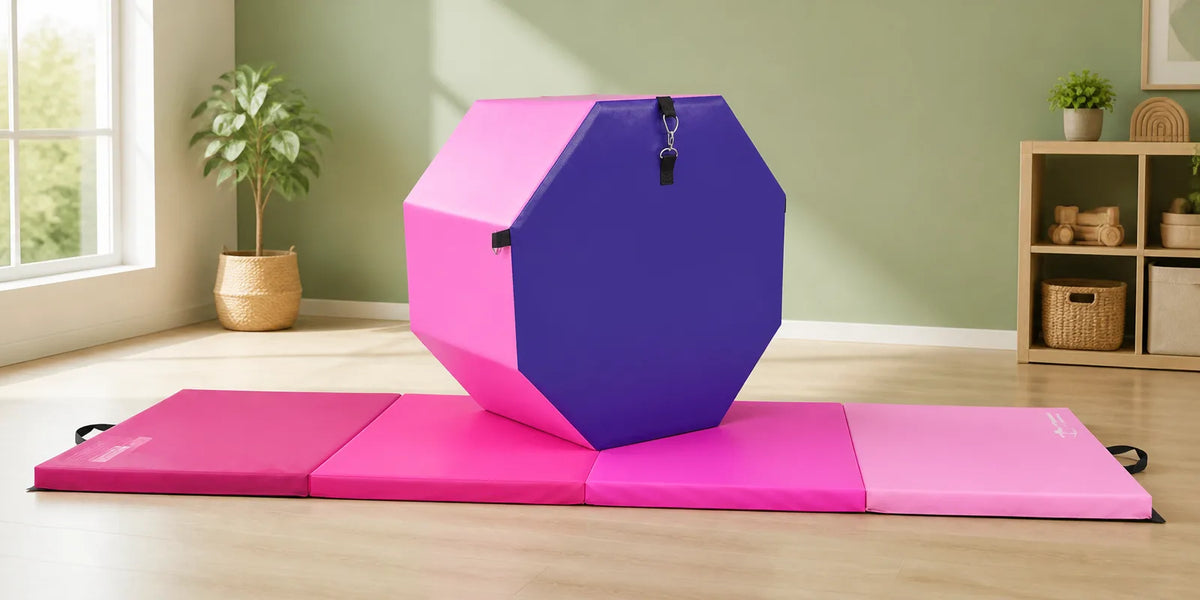
An octagon mat is a piece of training equipment with an eight-sided, barrel-like shape made from firm foam and covered in durable vinyl. It is designed to support body weight while still providing enough cushioning for safer skill practice.
Unlike a standard panel mat that lies flat or a wedge mat that creates an incline, an octagon mat helps the body move through a controlled rolling path. The flat sides slow the motion at each edge, which makes the rotation feel more stable and predictable.
You will often find octagon mats in the following:
- Gymnastics facilities
- Cheerleading programs
- Preschool movement classes
- Therapy and adaptive movement settings
- Home practice spaces for kids
Primary Uses of an Octagon Mat
1. Skill Development in Gymnastics
One of the main uses of an octagon mat is teaching foundational gymnastics skills. It helps athletes understand how to shift body weight, create rotation, and move through inverted positions with better support.
It is commonly used for:
- Forward rolls
- Backward rolls
- Front walkover progressions
- Back walkover progressions
- Handspring shaping drills
- Cartwheel and round off body positioning drills
For beginners, this matters because going upside down can feel unfamiliar and intimidating. The octagon shape gives the athlete a guided surface to move over instead of forcing them to figure out the entire path on a flat mat.
2. Tumbling and Cheerleading Training
In tumbling and cheer programs, octagon mats are often used as progression tools before athletes move to floor work without assistance. They help break larger skills into smaller, more manageable movement patterns.
In this setting, an octagonal mat can support the following:
- Backward movement confidence
- Shoulder opening and body tension drills
- Handspring entry practice
- Walkover timing and alignment
- Controlled shaping for beginner tumblers
For cheer athletes, it can also be useful when learning body control, air awareness, and movement rhythm before progressing to faster or more powerful tumbling passes.
3. Strength, Coordination, and Body Awareness
An octagon mat is not only for tricks. It also helps develop the physical qualities that make skill learning easier.
Repeated practice on an octagon mat can improve:
- Core strength
- Balance
- Coordination
- Proprioception
- Spatial awareness
- Shoulder and trunk control
These qualities matter because many early gymnastics and tumbling skills depend as much on body awareness as on strength. A child who learns how to rock, roll, climb, and shift weight confidently often builds a stronger movement base for future skill development.
4. Physical Therapy and Special Needs Training
The supportive design of an octagon mat also makes it useful in rehabilitation, adaptive physical education, and guided motor development settings. Its shape can encourage gentle movement exploration without the hard impact of more advanced training equipment.
Professionals may use it for:
- Controlled rolling patterns
- Balance work
- Motor planning exercises
- Sensory movement activities
- Supported coordination drills
This does not mean every therapy setting uses the same mat or the same drills. It means the shape itself can be useful when the goal is guided movement, controlled rotation, and safer body positioning.
5. Safe Play and Home Practice
For families, an octagon mat can also function as a structured movement tool at home. Kids often use it to climb, roll, rock, and practice beginner tumbling patterns in a more controlled environment than a hard floor, couch, or bed.
For home use, it is especially helpful for:
- Energy-burning movement play
- Beginner rolls
- Confidence building for going upside down
- Supervised preschool climbing and rocking
- Early gymnastics exposure before formal classes
That said, an octagon mat is still training equipment, not casual furniture. It works best with supervision, a clear floor area, and age-appropriate expectations.
Benefits of Using an Octagon Mat
1. Safety and Injury Reduction
The biggest benefit is that an octagon mat adds support during movement patterns that often feel unstable to beginners. The foam surface reduces impact, and the flat-sided design slows uncontrolled rolling.
This can help reduce the following:
- Sudden falls during early skill learning
- Fear during backward movement practice
- Joint stress from repeated drills on hard flooring
- Poor body positioning caused by hesitation
It is not a substitute for proper coaching, but it can make early progressions safer and more approachable.
2. Faster Skill Progression
An octagonal mat helps athletes feel the path of a movement. That matters because many gymnastics skills are difficult not only because they require strength but also because they require timing, shape, and confidence.
When an athlete understands the movement path sooner, they can often progress more efficiently through the following:
- Rolling drills
- Walkover confidence work
- Entry mechanics for handsprings
- Basic inversion comfort
This makes the mat especially valuable for beginners who need physical support and psychological reassurance at the same time.
3. Confidence Building
Fear is one of the biggest barriers in beginner tumbling and gymnastics. Going backward or upside down can make even simple drills feel overwhelming.
An octagonal mat helps reduce that fear by making the movement more predictable. Athletes often commit more fully when they know the equipment is helping guide their body through the skill.
4. Versatility Across Ages and Skill Levels
Another major advantage is versatility. A smaller child may use an octagon mat for climbing, rocking, and rolling, while an older beginner may use a larger version for walkover and handspring progressions.
Over time, the same mat may serve different purposes:
- Early movement exploration
- Beginner tumbling progressions
- Warm-up drills
- Conditioning circuits
- Obstacle-based coordination activities
How to Choose the Right Octagon Mat
1. Size and Athlete Height
Size is one of the most important buying factors. A mat that is too small may not give enough support through the motion, while a mat that is too large can feel awkward and difficult for a smaller child to control.
In general:
- Smaller octagons work well for toddlers, preschoolers, and basic rolling play.
- Medium sizes often fit beginner gymnasts working on rolls and walkovers.
- Larger octagons are better for taller users and bigger tumbling progressions.
The best fit depends on the user’s height, strength, confidence level, and the specific skills being practiced.
2. Foam Density and Support
Foam quality affects both performance and safety. A mat that collapses too easily may not provide enough support, while a mat that is overly hard can feel less forgiving.
Look for foam that offers:
- Firm support under body weight
- Consistent shape retention
- Enough cushioning for repeated drills
- Reliable performance over time
For regular gymnastics use, dense foam usually performs better than low-quality foam that compresses quickly.
3. Cover Material and Durability
The outer cover should be durable, easy to clean, and able to handle repeated friction. Heavy-duty vinyl is common because it resists tearing and wipes down easily.
Useful features include:
- Reinforced stitching
- Strong handles when included
- Tear-resistant cover material
- Easy clean surface
- Non-slip contact with the floor when used properly
4. Intended Use and Training Environment
Think about where and how the mat will be used before buying.
A facility may need:
- Heavier-duty construction
- Frequent daily use durability
- Sizing that matches structured progressions
A home user may care more about:
- Storage space
- Ease of moving the mat
- Age-appropriate size
- Multipurpose use for play and beginner practice
Octagon Mats vs. Other Gym Mats
Because shoppers often compare training mats before buying, it helps to understand where an octagon mat fits.
Octagon Mat vs. Wedge Mat
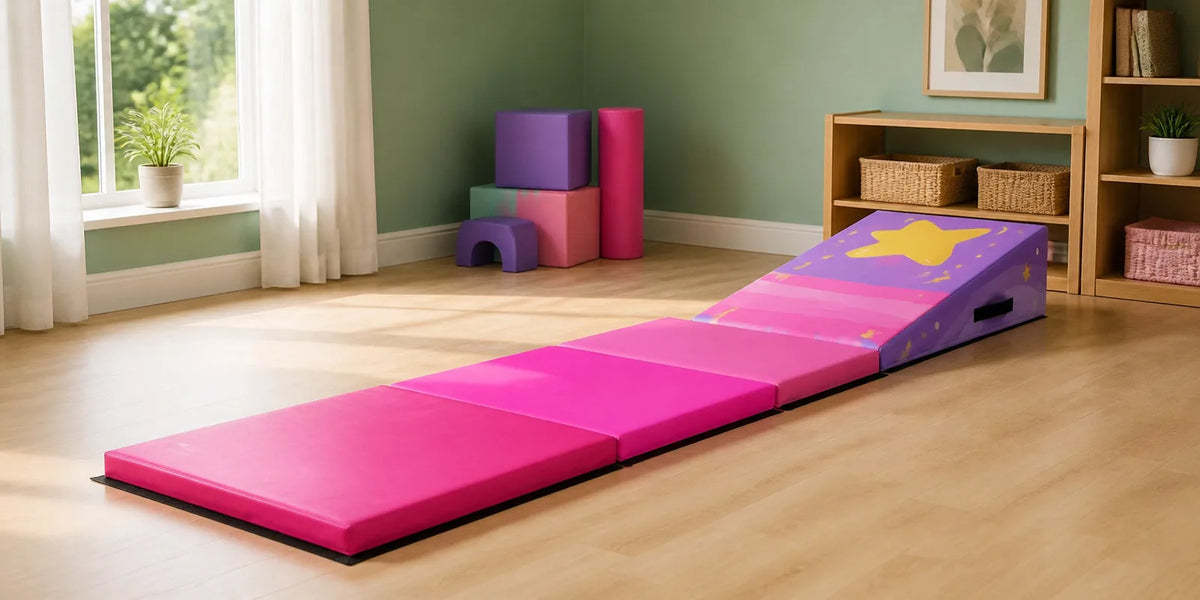
A wedge mat creates an incline, which helps with downhill momentum and certain shaping drills. An octagonal mat supports rolling and backward movement more directly by giving the body a rounded but controlled path.
Octagon Mat vs. Barrel Mat
A barrel mat rolls more continuously. An octagonal mat offers more stopping points because of its flat sides, which usually gives beginners better control.
Octagon Mat vs. Panel Mat
A panel mat is useful as a floor surface and landing layer, but it does not guide rotation. An octagonal mat is better when the goal is learning how to move through rolling or inverted patterns.
Tips for Safe and Effective Use
Use an octagon mat the same way you would use any movement training tool, with a focus on setup, progression, and supervision.
- Always supervise children during use.
- Place the mat on a clean, stable, non-slip surface.
- Use additional padding when practicing near hard flooring.
- Start with simple drills before attempting harder progressions.
- Keep the area clear of furniture, walls, and sharp objects.
- Treat the mat as a skill-building aid, not as protection for advanced unsupervised tumbling.
FAQs
Do beginners need an octagon mat?
No, it is not mandatory. Yes, it can be extremely helpful. For beginners, the mat often makes rolling and inverted movement feel safer, clearer, and less intimidating.
Can adults use an octagon mat?
Yes, if the mat is large and dense enough to support adult body weight. Adults in beginner gymnastics, tumbling progressions, or guided rehab work may still benefit from it.
What age can kids start using an octagon mat?
Some children start using small octagon mats around ages two to three for supervised climbing, rocking, and basic rolling play. More skill-specific tumbling use usually depends on maturity, coordination, and close supervision rather than age alone.
Is an octagonal mat good for back handsprings?
It can be useful for back handspring progressions, shaping drills, and confidence work. It should not be treated as a complete substitute for proper coaching, spotting, and appropriate landing surfaces.
How is an octagon mat different from a wedge or cheese mat?
A wedge mat uses an incline to create directional momentum. An octagon mat helps guide rotation through a rounded path with more control at each edge, which is why many coaches and parents use it for rolls, walkovers, and backward-movement drills.
Conclusion
An octagon mat is used to support safer rolling and tumbling progressions, coordination work, and beginner inversion training in gymnastics, cheer, therapy, and home practice. Its shape helps users move through rotation with more control than a flat mat, which makes it especially valuable for rolls, walkovers, handspring drills, and confidence-building. When chosen in the right size and used with supervision, it can be a versatile tool for both skill development and structured movement play.

Leave a comment
This site is protected by hCaptcha and the hCaptcha Privacy Policy and Terms of Service apply.