
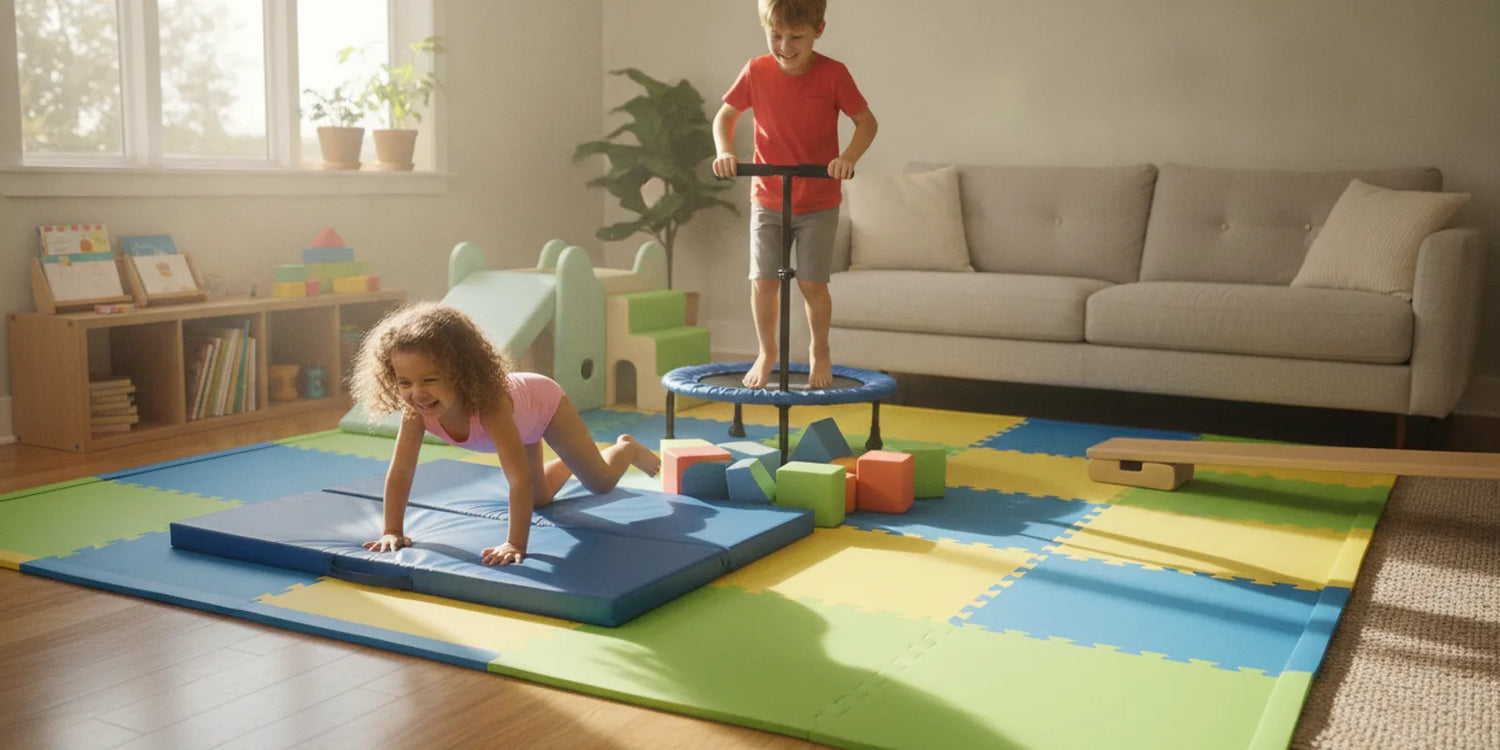
Choosing the right floor pads for kids can be the difference between a safe, confidence-building play space and one that puts young bodies at risk. Whether you are setting up a playroom, a bedroom corner, or a home gymnastics area, the type, thickness, and safety certification of your floor padding all matter.
This guide walks parents through every key decision: which pad type suits which activity, how to measure your space, what safety labels to trust, and which Kangaroo Hoppers mats fit your child's age, skill level, and budget.
Quick Answer: The best floor pads for kids depend on the activity: interlocking EVA foam tiles at least 5/8 inch thick suit general play and bedrooms, while purpose-made gymnastics tumbling mats at 2 inches or more are needed for rolls, jumps, and cartwheels. Always look for ASTM F963 or EN71 certification and BPA-free, phthalate-free foam.
Table of Contents
- Why Do Kids Need Padded Floors?
- What Types of Floor Pads Are Available for Kids?
- How Thick Should Floor Pads Be for Kids?
- What Safety Standards Should Kids' Floor Pads Meet?
- Which Kangaroo Hoppers Floor Pad Is Right for Your Child?
- What Mistakes Should You Avoid When Buying Floor Pads for Kids?
- How Do You Clean and Maintain Kids' Floor Pads?
Key Takeaways
- Activity Determines Thickness: General play needs at least 5/8-inch EVA tiles; gymnastics tumbling requires 2 inches or more of dedicated mat cushioning.
- Safety Certifications Matter: Look for ASTM F963 and EN71 labels, which confirm the foam has been independently tested and is free from lead, phthalates, BPA, and formaldehyde.
- Surface Type Affects Injury Risk: Systematic reviews show non-impact-absorbing surfaces increase fall injury risk in young children, making padded flooring a practical safety investment.
- Measure First, Buy Second: Calculate square footage of your play area before purchasing tiles, and add at least 12 inches of padded border beyond the active zone.
- Start With a Bundle, Upgrade Later: The Kangaroo Hoppers Starter Home Gym Bundle suits beginners, while the Tumbling Bundle covers families ready for more structured gymnastics practice at home.
Why Do Kids Need Padded Floors?
Kids need padded floors because hard surfaces dramatically increase the severity of fall injuries, and children fall frequently during active play. A study of US emergency department data found that 74% of fall injuries in children involved consumer products, with floors and stairs among the leading categories.[1]
A systematic review of fall risk factors in children under 6 found that surface type is a key predictor of injury severity, with non-impact-absorbing surfaces associated with a 1-2 fold increase in injury risk.[2]
"For the past 20 years, I have focused on researching risk factors for injury in youth sports and developing strategies for injury prevention. My goal is to expand opportunities for all youth to reap all the health benefits of participating in sports and physical activities while reducing their risk for injury."
Cynthia R. LaBella, MD, FAAP, Medical Director of the Institute for Sports Medicine, Ann & Robert H. Lurie Children's Hospital of Chicago
Beyond falls, padded flooring supports joint comfort during longer play sessions, reduces noise transfer in multi-story homes, and gives children a defined, inviting space for active movement. According to CPSC impact attenuation testing, purpose-made mat materials provide significantly better shock absorption than carpeting with padding for indoor play areas, making dedicated floor pads a meaningful upgrade over standard carpet.
What Types of Floor Pads Are Available for Kids?
Floor pads for kids fall into three main categories: interlocking EVA foam tiles for everyday play, gymnastics and tumbling mats for high-impact activities, and wedge or incline pads for skill development. Each serves a distinct purpose, and many families use more than one type.
Are Interlocking EVA Foam Tiles Good for Playrooms and Bedrooms?
Interlocking EVA foam tiles are the most versatile option for general playrooms and bedrooms, offering waterproof, non-toxic cushioning that is easy to install and rearrange. Flooring specialists widely describe EVA foam as non-toxic, BPA-free, and waterproof, with standard kids' tiles typically 5/8 inch thick for general play.
- Modular design: Tiles lock together without adhesive, so you can expand, shrink, or reconfigure the play area as your child grows.
- Easy cleaning: The closed-cell foam surface repels liquids, making spills simple to wipe away with a damp cloth.
- Color and pattern options: Bright interlocking sets encourage children to help set up their own space, which builds ownership and enthusiasm for active play.
- Limitation: Standard 5/8-inch tiles cushion everyday tumbles but are not deep enough for deliberate gymnastics practice involving jumps or rolls.
When Should Kids Use Gymnastics and Tumbling Mats?
Gymnastics and tumbling mats are purpose-built for high-impact activities such as rolls, cartwheels, jumps, and handstands, providing the extra depth and structural support that interlocking tiles cannot match. Explore the full range in the Kangaroo Hoppers gymnastics mat collection to find the right fit for your child's skill level.
- Thickness: Typically 2 inches or more, absorbing the impact of repeated landings that would compress thinner tiles.
- Vinyl cover: A tough outer shell protects the foam core, resists abrasion from sliding feet, and wipes clean quickly.
- Recommended use: Any child who is learning forward rolls, cartwheels, or beginner-level tumbling should practice on a dedicated gymnastics mat rather than standard play tiles.
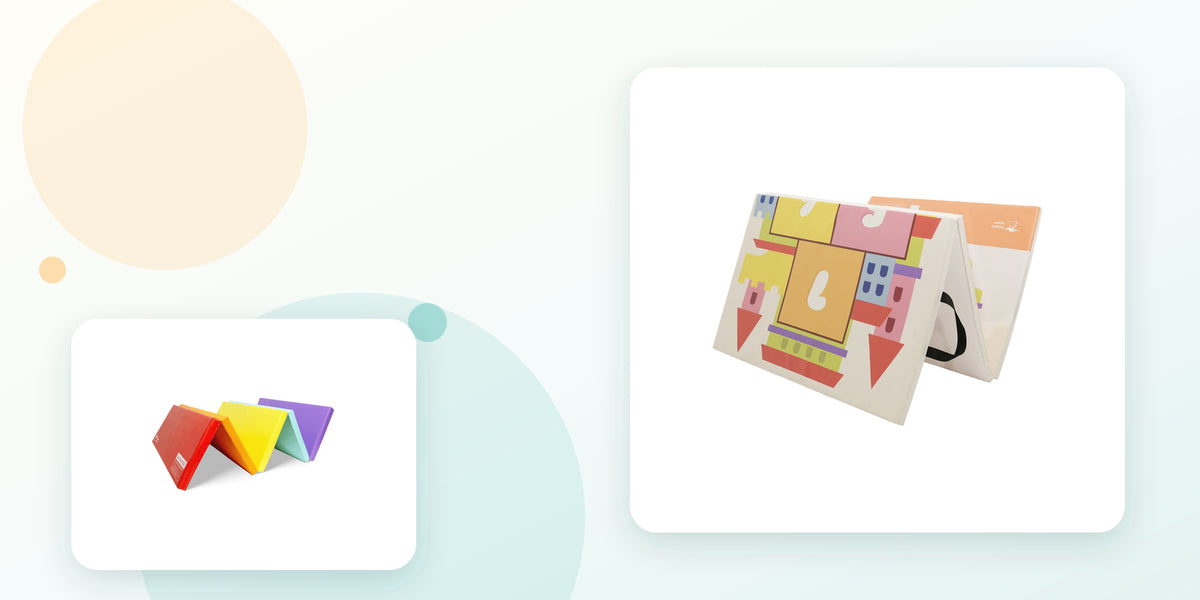
The Kangaroo Hoppers Kids Rainbow Tumbling Cheese Wedge Mat Pad Combo pairs a flat landing mat with a wedge-shaped incline, giving beginning gymnasts the support structure to learn rolls and jumps safely.
How Do Wedge and Incline Pads Help Kids Build Skills?
Wedge and incline pads create an angled surface that reduces the effort needed to initiate rolls and handstands, making them ideal for children learning foundational gymnastics movements. The Kangaroo Hoppers Incline Gymnastics Mat is designed to guide the body naturally through a forward roll, lowering the fear threshold for young beginners.
- Best for ages 4 and up: Children need basic coordination to use a wedge safely, but the shape actively supports that coordination development.
- Pairs with flat mats: Position a flat landing mat at the base of the wedge to extend the cushioned zone beyond the pad itself.
- Skill progression: As confidence grows, the wedge can be used at steeper angles or combined with obstacle sequences using the Kangaroo Hoppers Kids Gymnastics 3 Blocks Set.
This buyer's guide walks through the key features to compare when selecting foam play mats for kids, from thickness and certification labels to material safety ratings.
How Thick Should Floor Pads Be for Kids?
The right thickness for kids' floor pads depends on the activity: at least 5/8 inch for everyday play and bedroom use, and at least 2 inches for gymnastics and tumbling practice. Thicker foam absorbs more impact energy on landing, which directly reduces stress transferred to knees, wrists, and ankles.
What Thickness Works for Each Activity?
Different activities put different levels of impact force through a floor pad, so thickness should match the most demanding movement your child will perform on that surface.
- Crawling, sitting, building games (ages 1-4): 5/8-inch EVA tiles provide adequate cushioning for low-impact floor play and protect against minor topples.
- Running, jumping, rough-and-tumble play (ages 4-10): Look for tiles at least 5/8 inch thick, ideally closer to 3/4 inch, for sustained active sessions.
- Beginner gymnastics, rolls, cartwheels (ages 4+): A minimum of 2 inches of dedicated mat thickness is recommended for repetitive impact activities.
- Tumbling, jumps, handstands (ages 6+): A flat tumbling mat paired with a cheese wedge gives the depth and angle support that skill development requires.
How Do You Measure Your Space Before Buying?
Measure the full length and width of your intended play area in feet, then add at least 12 inches of cushioned coverage on each open side beyond the active zone. This buffer zone catches off-balance stumbles and ensures children land on padding even when they step or roll past the central practice area.
- Calculate square footage: Multiply length by width to get total area, then select a tile set that covers that figure plus your buffer margin.
- Account for furniture: Subtract floor space occupied by fixed items like balance beams or storage units before ordering tiles.
- Plan for growth: Modular interlocking sets are easy to expand later, so buying a slightly smaller starting set and adding tiles as the space grows is a sensible budget strategy.
- Check ceiling height: For any jumping or tumbling activity, confirm at least 8 feet of overhead clearance to prevent accidental contact with light fixtures or fans.
What Safety Standards Should Kids' Floor Pads Meet?
Kids' floor pads should carry ASTM F963 (US Toy Safety Standard) and EN71 (EU Toy Safety Standard) certification, which confirm independent testing for harmful substances including heavy metals, phthalates, BPA, formaldehyde, and formamide. These marks are the minimum baseline a responsible parent should require before placing any foam product in a child's play space.
What Do ASTM F963 and EN71 Actually Test?
Reputable floor pads for kids carry ASTM F963 and EN71 certifications, indicating independent laboratory testing for heavy metals, phthalates, and chemical emissions. These standards are not self-declared: a manufacturer must submit products to an accredited third-party lab and publish the resulting certificates.
- ASTM F963: The US consumer product safety standard for toys and children's products, including foam floor coverings marketed for children.
- EN71: The European equivalent, often cited alongside ASTM F963 by brands selling globally; it specifically tests for formamide, a compound sometimes found in EVA foam.
- CPSIA: US legislation that requires children's products to meet lead and phthalate limits and carry a Children's Product Certificate from an accredited lab.
- Transparency signal: Brands that publish actual lab test PDFs on their product pages provide a stronger trust signal than those that only print certification logos.
Pair your floor pads with the Kangaroo Hoppers Kids Gymnastics Wrist Guards for an added layer of protection during active gymnastics sessions, particularly when children are first learning to support body weight on their hands.
Is EVA Foam Safe for Kids?
High-quality EVA foam is widely regarded as safe for children when it meets ASTM F963 and EN71 standards, as it is non-toxic, BPA-free, phthalate-free, latex-free, and uses a closed-cell structure that prevents liquid absorption. A systematic review of playground safety interventions found that replacing non-absorbing hard surfaces with impact-absorbing materials reduced injury rates, reinforcing the value of certified foam flooring in kids' active spaces.[3]
- Closed-cell structure: Means liquids stay on the surface rather than soaking in, which limits mold and mildew growth and makes routine cleaning straightforward.
- No latex: EVA foam is inherently latex-free, making it suitable for children with latex sensitivities.
- Odor check: Fresh EVA foam may have a mild scent that dissipates within a few days of airing out; a persistent strong chemical odor may indicate lower-grade materials and warrants checking for certification documentation.
Which Kangaroo Hoppers Floor Pad Is Right for Your Child?
The right Kangaroo Hoppers floor pad or mat depends on your child's age, activity level, and available space, with options ranging from a beginner bundle for general active play to a full tumbling setup for developing gymnasts. The table below maps each product to its best use case so you can match equipment to your child's actual needs rather than guessing.
How Do the Kangaroo Hoppers Options Compare?
Use this guide to find the Kangaroo Hoppers floor pad that fits your child's activity, space, and budget. All options are designed for kids and teens doing active play or beginner gymnastics at home.
| Product | Best For | Activity Type | Ideal User |
|---|---|---|---|
| Tumbling Cheese Wedge Mat+Pad Combo | Tumbling and gymnastics practice | High-impact, rolls and jumps | Beginners learning rolls and jumps |
| Incline Gymnastics Mat | Skill-building on an angled surface | Cartwheel and handstand assist | Ages 4+ learning foundational moves |
| Gymnastics 3 Blocks Set | Obstacle courses and balance training | Modular stacking and jumping | Supplement to floor pad setup |
| Starter Home Gym Bundle | General active play, all-in-one | Mixed beginner activity | Best entry-level option for families |
| Tumbling Home Gym Bundle | Full gymnastics and tumbling setup | Intermediate skill development | Best upgrade path for growing gymnasts |
If your child is just starting out and you are unsure how much space or equipment you need, the Starter Home Gym Bundle for Kids is the lowest-commitment entry point. Families who know their child is serious about gymnastics practice will get more long-term value from the Tumbling Home Gym Bundle for Kids, which provides the full mat setup needed for skill progression.
For a broader look at equipment that pairs well with floor pads, see the guide to best gymnastics toys for kids. You can also set up an exciting active-play zone by combining floor mats with tools like the 8ft Balance Beam Gymnastic Equipment for Kids, which requires a padded landing area on both sides.
What Mistakes Should You Avoid When Buying Floor Pads for Kids?
The most common mistake when buying floor pads for kids is choosing thickness based on price rather than activity, which results in a surface that looks safe but compresses completely on impact during jumps or rolls. A pad that bottoms out offers little more protection than the hard floor beneath it.
- Skipping certification checks: Not all EVA foam products are tested for harmful substances. Always verify ASTM F963 or EN71 certification before purchasing, and look for a published lab test certificate rather than a printed logo alone.
- Undersizing the coverage area: Buying just enough tiles to cover the intended activity zone leaves hard floor exposed on the edges, exactly where stumbling children are most likely to land. Build in a 12-inch cushioned border on every open side.
- Using puzzle tiles for gymnastics: Standard interlocking tiles are not designed to absorb repetitive gymnastics impacts. Using them as a substitute for a proper tumbling mat puts wrists, knees, and elbows at unnecessary risk during rolls and jumps.
- Ignoring ceiling height: A padded floor means nothing if a child jumps and hits an overhead light fitting. Confirm at least 8 feet of clearance before allowing jumping activities.
- Forgetting to check underneath: Moisture trapped under foam tiles, especially in basements or ground-floor rooms, can promote mold. Lift tiles periodically and let both surfaces air out.
Add wrist and joint protection alongside your floor pads: Kangaroo Hoppers Kids Gymnastics Wrist Guards are designed to support young wrists during handstand and cartwheel practice, reducing the jarring impact that comes with learning new weight-bearing skills.
How Do You Clean and Maintain Kids' Floor Pads?
Clean kids' floor pads by wiping the surface with a damp cloth and mild soap, then air drying completely before reassembling tiles or storing the mat. This routine keeps the foam hygienic without degrading the material or stripping surface textures that help prevent slipping.
- Daily wipe-down: A quick pass with a damp cloth removes dust, food residue, and surface grime that accumulates during active play sessions.
- Mild soap for deeper cleaning: A few drops of dish soap in water is sufficient. Avoid harsh chemical cleaners, bleach, or abrasive scrubbers, which can break down the foam surface over time.
- Moisture management for interlocking tiles: Lift individual tiles periodically to check for trapped moisture on the underside, particularly in basements or rooms with humidity. Prop tiles on their edge to air dry both faces before replacing.
- Gymnastics mat care: Vinyl-covered mats wipe clean easily; pay attention to seams and zipper areas where grime can collect. Never fold a wet mat, as moisture trapped inside the foam core can lead to odor.
- Storage: Roll or fold gymnastics mats as directed by the manufacturer. Store interlocking tiles flat or stacked in a cool, dry space away from direct sunlight, which can gradually soften and discolor EVA foam.
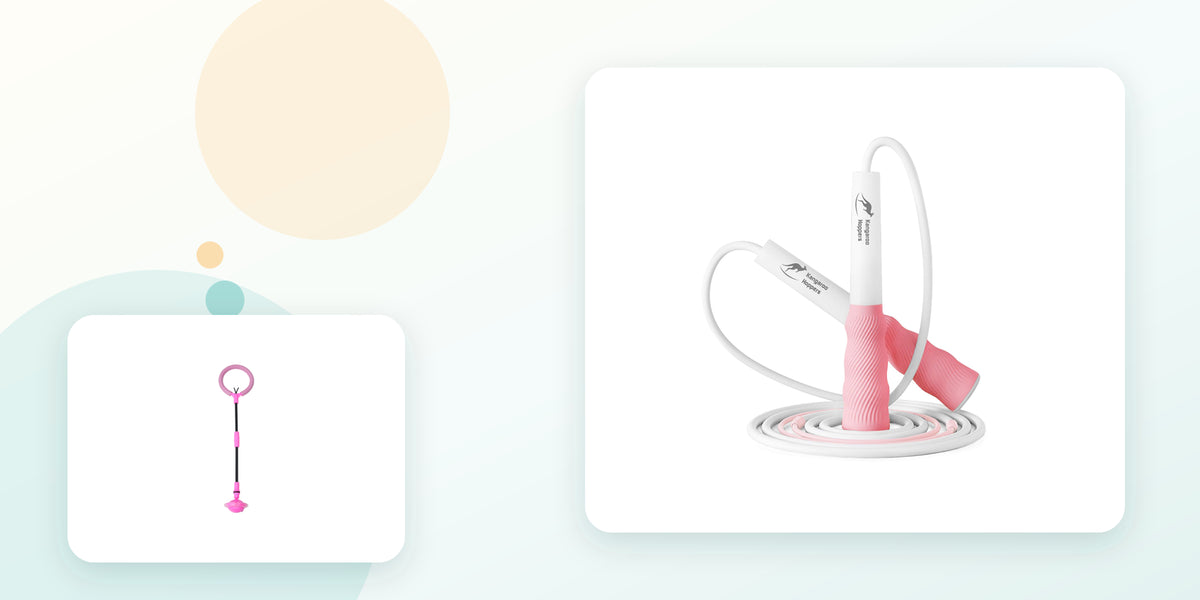
For active families who use their floor pads daily, consider adding the Kangaroo Hoppers Kids Jump Rope and Kangaroo Hoppers Kids Ankle Skip Ball to your padded space for a complete home active-play setup that keeps kids moving year-round.
FAQs About Floor Pads for Kids
What thickness of floor pad is best for kids doing gymnastics at home?
For basic gymnastics and tumbling at home, look for a mat at least 2 inches thick. Thicker mats absorb more impact during rolls, cartwheels, and jumps, reducing stress on knees and wrists. Standard 5/8-inch EVA tiles suit everyday play and active games but are not thick enough for dedicated gymnastics practice.
Are EVA foam floor pads safe for young children and toddlers?
High-quality EVA foam floor pads are considered safe for young children when they meet ASTM F963 and EN71 toy safety standards. Look for mats labeled BPA-free, phthalate-free, and free from heavy metals and formaldehyde. Always check that the product carries an independent lab test certificate rather than just a self-declared claim.
How do I clean foam floor pads for kids?
Wipe EVA foam floor pads with a damp cloth and mild soap, then air dry completely before reassembling tiles. Avoid harsh chemical cleaners or abrasive scrubbers, which can degrade the foam surface. For interlocking tiles, lift individual pieces periodically to check underneath for trapped moisture, especially in busy playrooms.
How much floor pad coverage do I need for a kids playroom?
Measure the full play area length and width in feet, then add at least 12 inches of cushioned border on each open side. A standard 6-tile set of 12-inch interlocking foam tiles covers around 16 square feet, suitable for a small corner play zone. A 36-tile set covers approximately 36 square feet for a larger room.
Can I use regular floor pads for gymnastics tumbling practice?
Standard thin EVA puzzle tiles are not designed for gymnastics tumbling because they lack the depth needed to cushion high-impact landings from jumps and rolls. Purpose-made gymnastics floor mats and tumbling mat-and-pad combos provide the extra thickness and structural support that beginner gymnasts need to practice safely at home without risking wrist or knee injuries.
What certifications should I look for when buying floor pads for kids?
Look for ASTM F963, EN71, and CPSIA compliance. These certifications confirm that the foam has been independently tested and found free from lead, phthalates, BPA, formaldehyde, and other harmful chemicals. A manufacturer that publishes lab test reports provides additional peace of mind for parents buying floor pads for young children.
Conclusion
Floor pads for kids are a practical investment in safer, more confident active play. Start with the right thickness for your child's activity level, confirm ASTM F963 or EN71 certification, and size the coverage area generously to include buffer space on all open sides.
Families new to home gymnastics will find the Kangaroo Hoppers Starter Home Gym Bundle a strong starting point, while those ready to develop tumbling skills should consider the Tumbling Home Gym Bundle for a complete padded practice setup.
Disclaimer
The information in this article is provided for general educational purposes and does not replace professional safety assessments or manufacturer installation guidelines for children's floor pads and gymnastics equipment. Always supervise children during active play and gymnastics practice, and consult a qualified gymnastics coach if your child is learning advanced skills at home.
References
1. Ali B, Lawrence B, Miller T, Swedler D, Allison J. Consumer Products Contributing to Fall Injuries in Children Aged <1 to 19 Years Treated in US Emergency Departments, 2010 to 2013: An Observational Study. Global Pediatric Health. 2019;6:2333794X18821941. https://pmc.ncbi.nlm.nih.gov/articles/PMC6328948/
2. Khambalia A, Joshi P, Brussoni M, Raina P, Morrongiello B, Macarthur C. Risk factors for unintentional injuries due to falls in children aged 0-6 years: a systematic review. Injury Prevention. 2006;12(6):378-381. https://pmc.ncbi.nlm.nih.gov/articles/PMC2564414/
3. Richmond SA, Clemens T, Pike I, Macpherson A. A systematic review of the risk factors and interventions for the prevention of playground injuries. Canadian Journal of Public Health. 2018;109(1):134-149. https://pmc.ncbi.nlm.nih.gov/articles/PMC6964629/

Leave a comment
This site is protected by hCaptcha and the hCaptcha Privacy Policy and Terms of Service apply.