
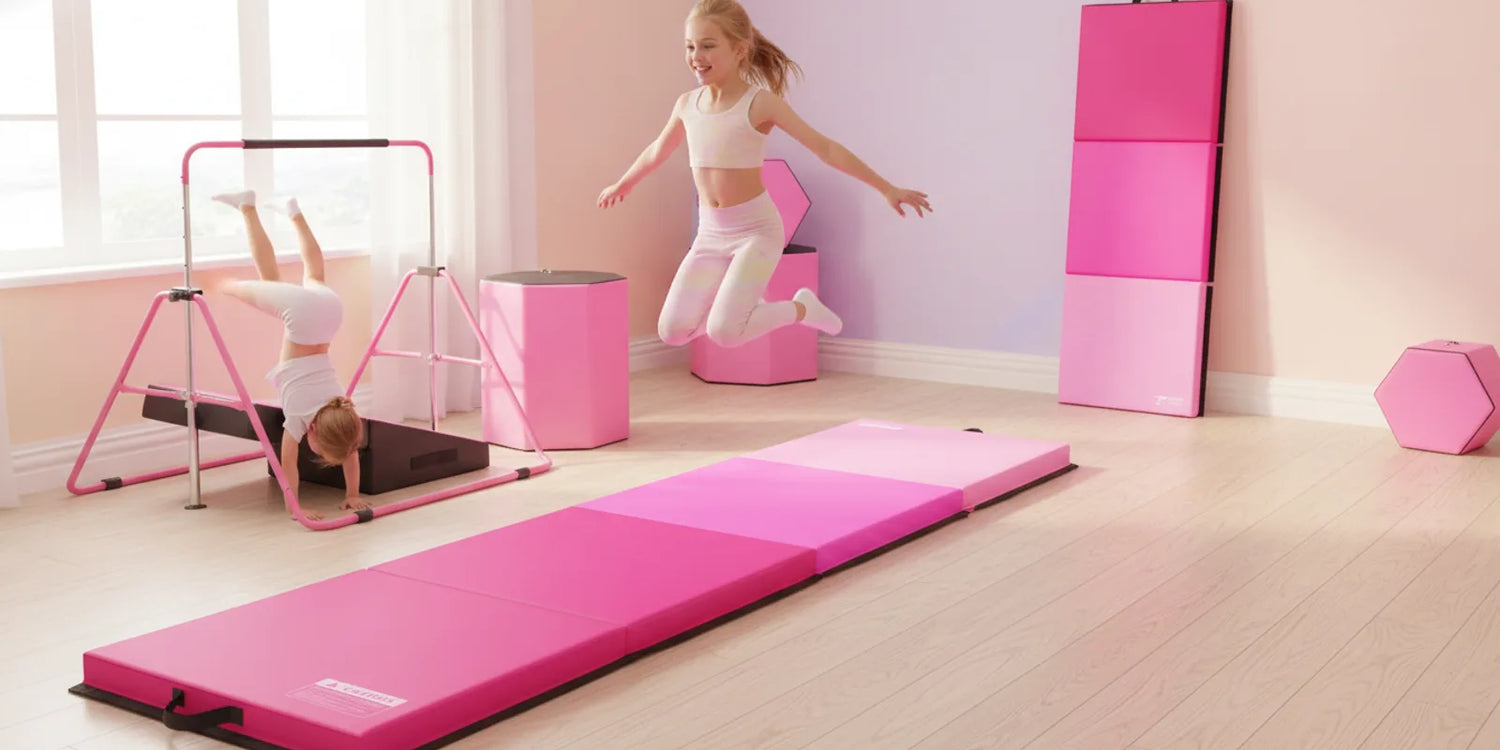
A gymnastics air track is one of the most practical pieces of home training equipment a young gymnast can have. It cushions landings, builds confidence for new skills, and stores away in minutes, making it ideal for families who want to support their child's gymnastics journey at home.
This guide covers everything parents and young gymnasts (ages 5-16) need to know: how to choose the right size and thickness, which skills to practise, how to set up safely indoors or outdoors, and how to avoid the most common mistakes.
Quick Answer: An air track for gymnastics is an inflatable mat that provides a cushioned, bouncy surface for practising skills like cartwheels, handstands, and tumbling at home. For most beginners aged 5 to 12, a 3-metre mat at 6-inch thickness is the best starting choice, offering safe landings, easy storage, and enough room to build real gymnastics skills.
Table of Contents
- What Is a Gymnastics Air Track?
- How Do You Choose the Right Air Track Size?
- What Skills Can Kids Practise on an Air Track?
- What Skills Can Intermediate Gymnasts Learn?
- How Do You Set Up an Air Track Safely?
- What Are the Most Common Air Track Mistakes?
- How Do You Maintain and Store an Air Track?
- What Safety Rules Should Every Parent Know?
Key Takeaways
- Best Starter Size: A 3-metre (10 ft) air track at 6-inch thickness suits most beginners aged 5-12, fitting a typical living room or garage and covering cartwheels, handstands, and basic tumbling.
- Skill Progression: Beginners (ages 5-8) should focus on rolls, cartwheels, and bridges. Intermediate gymnasts (ages 9-12) can progress to round-offs, back walkovers, and aerials as strength and confidence grow.
- Safety First: Always check and adjust air pressure before each session, clear the surrounding space of obstacles, and ensure overhead clearance is adequate for jumps and back skills.
- Indoor and Outdoor Use: Air tracks work on both surfaces. Outdoors, use a tarp or clean mat underneath to protect the PVC from sharp objects, gravel, and heat damage.
- Pair with Other Equipment: Combining an air track with a gymnastics beam or gymnastics bundles creates a well-rounded home training setup for young gymnasts.
What Is a Gymnastics Air Track?
A gymnastics air track is an inflatable mat filled with air that provides a bouncy, cushioned surface for practising gymnastics skills at home, in a studio, or outdoors. Unlike a standard foam mat, an air track absorbs impact through its air-filled chambers, reducing stress on the knees, ankles, and wrists during repeated drills and landings.
- Air track vs. foam mat: Air tracks offer adjustable firmness and a responsive bounce that foam mats cannot replicate. Gymnastics equipment brands note that air-filled mats reduce impact on joints, particularly the knees and ankles, making them suitable for kids who want to practise at home.
- Air track vs. trampoline: An air track sits close to the ground, which makes it far safer for tumbling and skill-building than a raised trampoline. The bounce is controlled rather than unpredictable, helping young gymnasts land with correct technique.
- Portability advantage: Most home air tracks inflate in 3-5 minutes with an electric pump and deflate just as quickly, folding into a carry bag for easy storage between sessions.
For families looking to support a young gymnast's training, an air track bridges the gap between gym sessions and home practice, letting children build muscle memory and confidence in a safe, supervised setting.
How Do You Choose the Right Air Track Size?
Choosing the right air track size depends on your child's age, skill level, available space, and how you plan to use it. The three key measurements to consider are length, thickness, and width, and getting each one right makes a significant difference to training quality and safety.
What Length Does Your Young Gymnast Actually Need?
According to gymnastics equipment guides, home-use air tracks around 3 to 5 metres long offer a practical balance of training space and ease of storage. A 3-metre (10 ft) mat fits in most living rooms or garages and gives beginners enough room for cartwheels, handstands, and tumbling elements.
If your child is working on round-offs or wants more run-up for tumbling passes, a 4 to 5-metre track is a better fit.
| Age Group | Recommended Length | Typical Skills |
|---|---|---|
| Ages 5-8 (Beginner) | Around 3 m (10 ft) | Rolls, cartwheels, handstands, bridges |
| Ages 9-12 (Intermediate) | Around 4 m (13 ft) | Round-offs, back walkovers, aerials |
| Ages 13-16 (Advanced) | Around 5 m (16 ft) or more | Tumbling passes, connected skills, back tucks |
Which Thickness Is Best for Home Use?
Gymnastics equipment guides recommend 6-inch (15 cm) thickness as the most versatile choice for most home gymnasts. It provides a good balance of bounce and stability for a wide range of skills.
- 4-inch: Firmer surface, sits closer to the floor. Suits beginners learning control and balance.
- 6-inch: Best all-round choice for home use, suitable for ages 5-16 across most skill levels.
- 8-inch and above: Maximum cushioning for higher-impact skills like back tucks, but requires extra ceiling clearance for jumps indoors.
Does Width Matter?
A width of around 1 metre (3-4 ft) is the standard for home air tracks and suits most individual practice sessions. Wider tracks feel more forgiving for beginners learning their balance on cartwheels and handstands, while standard-width tracks save floor space in smaller rooms.
For a complete home gymnastics setup, pairing your air track with an incline gymnastics mat for kids helps beginners progress to back walkovers and handspring entries more confidently. Check out our full range of gymnastics tumbling mats for complementary options.
What Skills Can Beginners (Ages 5-8) Practise on an Air Track?
Young gymnasts in the beginner stage (typically ages 5 to 8) can use an air track to safely build the foundational skills that underpin all future gymnastics training. The cushioned surface absorbs the impact of imperfect landings, which encourages children to try new movements without fear of falling hard.
- Forward and backward rolls: The soft, level surface makes rolls comfortable and safe, letting children focus on tucking their chin and staying round rather than bracing for impact.
- Cartwheels: The centre line printed on most air tracks helps young gymnasts align their hands and feet for a straight, controlled cartwheel.
- Handstands: Practising against a wall with the mat underneath reduces wrist strain and builds the shoulder and core strength needed for freestanding handstands.
- Bridges and backbends: The slight give of the mat supports the spine during bridge holds and back flexibility work.
Research on youth gymnasts shows that the biggest physical development gains, including lower body power and reactive strength, occur between ages 7 and 12, making this the ideal window to build strong gymnastics foundations through consistent home practice.[1] For more ideas on beginner skill sequences, see our guide to basic gymnastics skills for kids.
What Skills Can Intermediate Gymnasts (Ages 9-12) Learn on an Air Track?
As young gymnasts grow in strength and confidence, the air track becomes a valuable tool for progressing to more dynamic skills. The controlled bounce supports the learning process by giving gymnasts a forgiving surface to practise repeated attempts without the fatigue and joint stress of hard floors.
- Round-offs: The extra length of a 4 to 5-metre track allows a proper run-up, which is essential for generating the power behind a clean round-off.
- Back walkovers and front walkovers: The cushioned surface supports the overhead position during walkovers, making it easier to build the flexibility and strength to perform them independently.
- Aerials and side aerials: The bounce assists with the takeoff phase, helping gymnasts get enough height to practise the rotation of a no-handed cartwheel safely.
- Basic back tucks: With appropriate supervision, more advanced gymnasts can use the extra bounce of an 8-inch track to assist with the rotation phase of a back tuck.
A 2024 randomised controlled study in the Journal of Sports Science and Medicine found that jump-based interval training significantly improved vertical jump performance, anaerobic capacity, and aerobic fitness in young gymnasts over an 8-week period.[2] Regular at-home practice on an air track replicates this jump-based stimulus, supporting the physical development young gymnasts need to progress.
Watch this tutorial to see how an air track supports the step-by-step learning of a side aerial, from cartwheel foundation to the final no-handed rotation:
Once your child is ready to take their skills further, an adjustable gymnastics beam is the natural next step, bringing balance and beam-specific skills into the home training setup. The gymnastics kip bar bundle is also a great addition for gymnasts starting to explore bar skills alongside their floor work.
How Do You Set Up an Air Track Safely Indoors and Outdoors?
Setting up an air track correctly is as important as choosing the right size. A properly positioned and inflated mat dramatically reduces the risk of slips, tip-overs, and landing mishaps during practice.
What Does a Safe Indoor Setup Look Like?
Place the air track on a clean, flat surface, clear of furniture, door edges, and any objects that could be struck during jumps or tumbling. Before each session, check that overhead clearance is sufficient for the skills being practised.
Gymnastics equipment guides recommend checking and adjusting air pressure before each session, as temperature changes can cause some air loss overnight.
- Surface protection: Lay a rug or foam underlay beneath the track to prevent it from sliding on smooth floors and to protect the PVC base from scratches.
- Side clearance: Leave at least 1 metre of clear space on each side of the track to allow for off-centre landings.
- Pressure adjustment: Use firmer inflation for tumbling and bounding, and softer inflation for shaping work and younger beginners learning handstands.
How Do You Use an Air Track Safely Outdoors?
Outdoors, always place a tarp or clean mat underneath the air track to protect the surface from sharp objects, gravel, rough concrete, and thorns. Avoid setting up on hot asphalt or in prolonged direct sunlight, as extreme heat weakens PVC materials over time.
- Check the surface first: Walk the area before unrolling the track to clear any stones, sticks, or debris that could puncture the mat.
- Wind considerations: A deflated air track can catch wind easily. Keep it rolled until you are ready to inflate, and anchor the ends if conditions are breezy.
- Re-check pressure: Outdoor temperature changes are more pronounced than indoors, so always top up the pressure before starting.
"Proper warm-up, appropriate supervision, and equipment that matches a child's developmental level are the foundations of safe gymnastics participation and injury prevention."
Cynthia R. LaBella, MD, FAAP, Medical Director of the Institute for Sports Medicine, Ann & Robert H. Lurie Children's Hospital of Chicago
Sport-specific endurance research in artistic gymnastics highlights that training quality, repetition, and surface consistency all contribute to skill development.[3] Setting up your air track correctly ensures each practice session translates into genuine progress for your young gymnast.
What Are the Most Common Air Track Mistakes to Avoid?
Even with a quality air track, avoidable setup and usage errors can reduce training effectiveness and increase injury risk. Knowing these common mistakes in advance makes home training sessions safer and more productive.
- Skipping the pressure check: Practising on an under-inflated track causes the gymnast to "bottom out," losing the mat's protective bounce and risking wrist and ankle injuries on hard landings.
- Using it on rough or sharp surfaces without protection: Placing the mat directly on gravel, rough concrete, or splintered wood without a tarp underneath is the most common cause of punctures and slow leaks.
- Attempting skills without adequate ceiling clearance: For back walkovers, back tucks, and aerial work, check that there is enough headroom before the session begins, especially when using an 8-inch thick track, which raises the gymnast higher off the floor.
- Allowing unsupervised practice of new skills: An air track absorbs impact, but it does not replace proper spotting and supervision when a child is learning a new movement for the first time.
- Leaving the track inflated and outdoors overnight: Prolonged UV exposure and temperature drops reduce the lifespan of the PVC material. Always deflate, clean, and store the track after each session.
For more guidance on building a safe home training space, see our article on gymnastics levels guide for parents, which covers age-appropriate skill goals and what to expect at each stage of your child's development.
How Do You Keep an Air Track in Good Condition?
With proper care, a quality air track can last several years of regular home use. Maintenance is straightforward and takes only a few minutes after each session.
- Wipe down after every use: Use a damp cloth with mild soap to clean the surface, removing sweat, dust, and any outdoor debris. Allow it to dry fully before rolling it up.
- Check seams and valves regularly: Run your hand along the seams after deflating to feel for air escaping from small stress points. Use the included repair kit to patch minor punctures before they worsen.
- Store correctly: Roll the track loosely rather than folding it sharply at the same crease points each time, which weakens the fabric over time. Keep it in its carry bag in a cool, dry location away from direct heat sources.
- Avoid sharp jewellery and rough footwear: Remind children to practise barefoot or in gymnastics shoes, and remove any rings or bracelets before stepping on the mat.
Looking for more gymnastics equipment for your child's home setup? Explore gymnastics hanging rings to complete your training space.
What Safety Rules Should Every Parent Know?
An air track significantly reduces the impact of falls, but safe gymnastics training at home depends on consistent rules, not just good equipment. Parents play a central role in ensuring sessions remain productive and injury-free.
- Always warm up first: Five minutes of light movement (jumping jacks, arm circles, and gentle stretching) prepares muscles and joints before any gymnastics skill work.
- Match skills to the child's current level: Children should progress from simpler, well-executed skills to harder ones only when they are consistently landing the earlier skill with good form.
- One person on the track at a time: Multiple gymnasts jumping simultaneously creates unpredictable rebound patterns that increase collision and fall risk.
- No distractions: Remove pets, younger siblings, and obstacles from the training area before each session.
When Should a Child Stop Training on the Air Track?
Stop the session immediately if your child reports sharp joint pain in the wrists, ankles, or knees, or has taken a hard fall that affects their movement. Always allow adequate rest between sessions and consult a sports medicine professional if any pain persists.
For gift ideas and equipment bundles to complement your child's home gym, check out our collection of best gymnastics toys for kids for more ideas on what to add next.
FAQs About Air Track for Gymnastics
What size air track is best for kids just starting gymnastics at home?
For beginners aged 5 to 8, a 3-metre (10-foot) air track at 6-inch thickness is the most practical starting point. It fits in most living rooms or garages, offers room for cartwheels and handstands, and deflates quickly for storage. As skills progress, upgrading to a 4 to 5-metre track gives more run-up for round-offs.
Can kids use an air track outdoors?
Yes. Most air tracks work both indoors and outdoors. When setting up outside, place a tarp or clean mat underneath to protect the PVC surface from sharp objects or rough concrete. Avoid hot asphalt and prolonged direct sun, as heat weakens the material. Always check air pressure before each session, since overnight temperature changes cause slight deflation.
How thick should an air track be for gymnastics practice?
A 6-inch (15 cm) air track is the most versatile choice for young gymnasts at home, providing a good balance of bounce and stability for cartwheels, handstands, and basic tumbling. Beginners may prefer 4-inch for a firmer feel, while 8-inch models offer maximum cushioning for higher-impact skills but require more ceiling clearance indoors.
What skills can a child learn on a home gymnastics air track?
Young gymnasts can practise a wide range of skills at home on an air track. Beginners start with rolls, cartwheels, handstands, and bridges. As confidence and strength grow, intermediate gymnasts progress to round-offs, back walkovers, and aerials. The cushioned surface absorbs impact and helps children build muscle memory for harder gym floors.
How do you keep an air track in good condition?
After each session, wipe the surface with mild soap and water, then allow it to dry completely before rolling it up. Avoid folding it sharply or leaving it inflated in direct sunlight. Check the seams and valve regularly for leaks, and use the included repair kit for minor punctures. Storing it in a cool, dry place extends the lifespan significantly.
Is an air track safe for young children to use without supervision?
No. Children should always practise with adult supervision, especially when attempting new or higher-impact skills. Parents should ensure the area is clear of obstacles, ceiling clearance is adequate for jumps, and the mat is properly inflated before each session. Supervision helps correct form early and reduces injury risk as skills become more challenging.
Conclusion
A gymnastics air track gives young gymnasts the cushioned, bouncy surface they need to build real skills at home safely. Choosing the right length (around 3 metres for beginners), the right thickness (6 inches for most), and setting it up correctly makes the difference between a mat that sits unused and one that becomes the centrepiece of a genuine home training routine.
Start with the basics, progress at your child's pace, and explore our gymnastics mat collection for options that fit your space and budget.
Disclaimer
This article is intended for general information and educational purposes only and does not constitute professional medical, safety, or coaching advice. Always supervise children during gymnastics practice, ensure equipment is suitable for your child's age, weight, and skill level, and consult a qualified gymnastics coach or paediatric sports medicine professional before introducing new high-impact skills or training programs.
References
1. Schärer C, Reinhart L, Hübner K. Age-Related Differences between Maximum Flight Height of Basic Skills on Floor, Beam and Vault and Physical Condition of Youth Female Artistic Gymnasts. Sports (Basel, Switzerland). 2023;11(5). https://pmc.ncbi.nlm.nih.gov/articles/PMC10222853/
2. Ma D, Silva RM, Xu Q, Wang K, Zhao Z. Jumping Interval Training: An Effective Training Method for Enhancing Anaerobic, Aerobic, and Jumping Performances in Aerobic Gymnastics. Journal of Sports Science & Medicine. 2024;23(2):410-417. https://pmc.ncbi.nlm.nih.gov/articles/PMC11149082/
3. Mkaouer B, Amara S, Bouguezzi R, Ben Abderrahmen A, Chaabene H. Validity of a new sport-specific endurance test in artistic gymnastics. Frontiers in Sports and Active Living. 2023;5:1159807. https://pmc.ncbi.nlm.nih.gov/articles/PMC10165550/


Leave a comment
This site is protected by hCaptcha and the hCaptcha Privacy Policy and Terms of Service apply.