
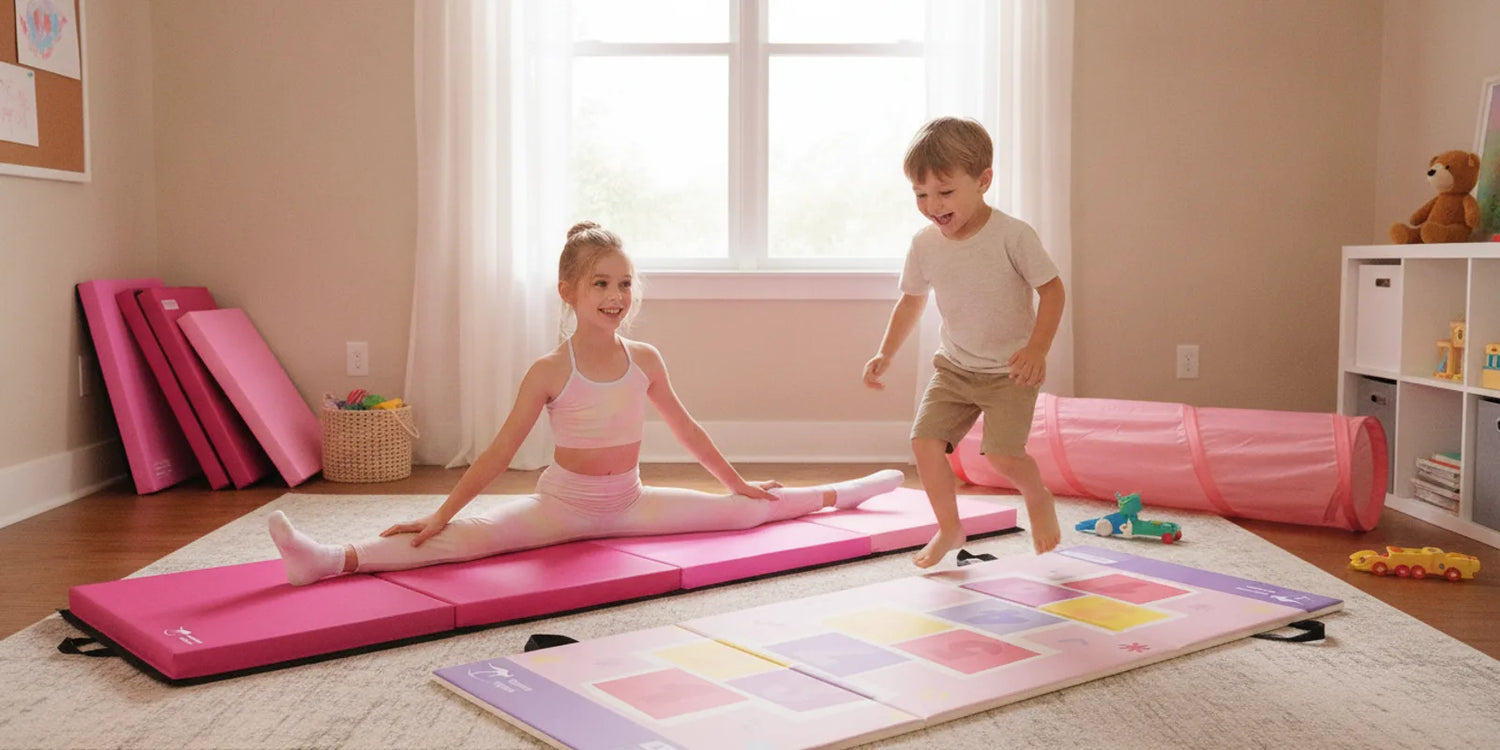
Choosing the right kids mat for the floor is one of the most practical safety decisions a parent can make for a playroom, bedroom, or home gym space. The wrong mat can slip, off-gas chemicals, or bottom out under an active child, while the right one turns any hard floor into a certified landing zone for crawling, tumbling, and play.
This guide covers mat types, thickness by age, non-toxic certifications, correct setup, and a clear Kangaroo Hoppers product comparison for children ages 0 to 12.
Quick Answer: The best kids mat for the floor depends on age and activity: infants need a certified non-toxic foam mat at least 0.5 inches thick for tummy time and crawling, while active school-age children doing gymnastics or tumbling need a foldable mat with high-density EPE foam and a vinyl outer shell for real impact protection.
Table of Contents
- Why the Right Floor Mat Matters for Kids
- What Types of Kids Mats for the Floor Are Available?
- How Thick Should a Kids Floor Mat Be?
- What Should You Look for in Mat Material Safety?
- How Do You Measure, Place, and Secure a Kids Floor Mat?
- Which Kangaroo Hoppers Floor Mat Is Right for Your Child?
- How Do You Keep a Kids Floor Mat Clean and Safe Long-Term?
Key Takeaways
- Thickness matters by age: Infants need at least 0.5 inches for crawling; active toddlers and school-age kids doing gymnastics benefit from 1.5 to 2 inches for real impact protection on hard floors.
- Certifications are non-negotiable: Look for CPSIA compliance, EN-71 testing, and explicit phthalate-free, formamide-free labels rather than vague "non-toxic" claims that carry no legal definition.
- Mat type determines use case: Foam play mats suit infants and toddlers; foldable gymnastics and tumbling mats are built for active children ages 3 to 12 who need a surface that absorbs real impact.
- Safety setup counts as much as the mat itself: Leave a 12-inch buffer from hard furniture edges and ensure interlocking tiles lie completely flat to eliminate tripping hazards at seams.
- EPE foam outperforms thin puzzle tiles for active kids: High-density EPE foam in tumbling mats holds its shape through repeated use, while budget puzzle tiles can compress and flake over time, creating surface hazards.
Why Does the Right Floor Mat Matter for Kids?
A dedicated kids floor mat matters because hard flooring such as tile, hardwood, and laminate provides zero impact absorption, and children spend a significant portion of their active time at or near floor level. According to U.S. Consumer Product Safety Commission testing, dedicated mat surfaces outperform carpeting for child fall protection indoors, with mat samples offering the best impact attenuation per unit thickness across all materials tested.
"Physical activity is great for kids and sports are a great way to get that physical activity. Just make sure the sport and schedule match a child's developmental and fitness level."
Cynthia R. LaBella, MD, Medical Director of the Institute for Sports Medicine, Ann and Robert H. Lurie Children's Hospital of Chicago
How Do Kids Use Floor Mats Differently from Adults?
Children interact with floor surfaces far more intensively than adults, spending time crawling, rolling, sitting, and tumbling at ground level where chemical exposure and fall risk are both higher.
- Ground-level exposure: Young children place hands and faces directly on mat surfaces, making non-toxic materials a stricter requirement than for adult fitness equipment.
- Unpredictable falls: Children fall sideways, backward, and from climbing heights, requiring mats that absorb multi-directional impact rather than just vertical compression.
- Developing bones: Growing bones and cartilage are more vulnerable to impact stress than adult bone, making adequate cushioning a genuine safety concern rather than a comfort preference.
What Types of Kids Mats for the Floor Are Available?
Kids floor mats fall into three main categories, each designed for a different age range and activity level: foam play mats for infants and toddlers, interlocking puzzle tiles for general playroom coverage, and gymnastics or tumbling mats for active children ages 3 and up.
Which Mat Is Best for Infants and Crawlers?
Soft foam play mats in one-piece or large-tile formats provide a clean, padded surface for tummy time, crawling practice, and early walking, with enough cushion to absorb the minor tumbles of a child still developing balance.
- Typical thickness: 0.4 to 0.5 inches suits infants under 12 months; increase to 0.5 to 0.8 inches once the child starts pulling to stand.
- Surface priority: A non-porous, wipe-clean surface matters most at this stage because infants mouth everything they contact.
- Size guide: A 4 by 6 foot mat covers sufficient space for tummy time, crawling play, and a caregiver sitting alongside.
Are Interlocking Puzzle Tiles a Good Option for Playrooms?
Interlocking EVA foam tiles let parents cover large playroom areas at lower cost, but the quality gap between budget and premium tiles is significant for households with active toddlers.
- Coverage advantage: Tiles can be arranged to fit any room shape and expanded over time by adding more pieces.
- Thickness limitation: Most puzzle tiles are 0.375 to 0.5 inches thick, which suits light play but provides minimal protection for children who fall from standing or climbing heights.
- Seam maintenance: Loose seams between tiles create tripping edges and gaps where moisture can accumulate; inspect and press tiles flat regularly.
When Should You Choose a Gymnastics or Tumbling Mat?
For children ages 3 to 12 who practice cartwheels, handstands, rolls, or any active floor gymnastics, a dedicated tumbling mat with thick EPE foam filling delivers far greater impact protection than general-purpose puzzle tiles.
- Foam density matters: High-density EPE foam holds its shape through repeated landings, while low-density budget mats compress over time and lose their protective value.
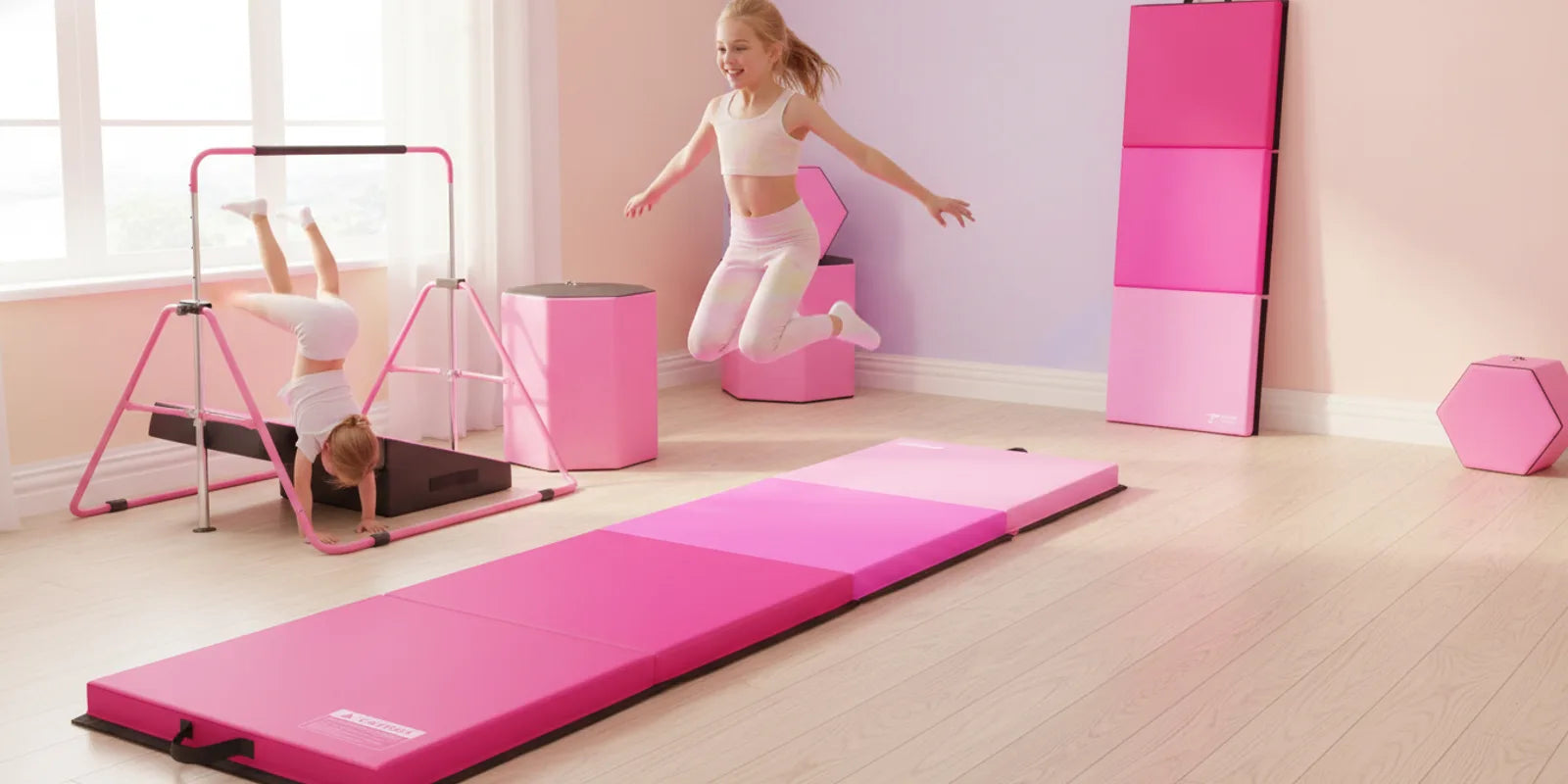
- Foldable design: Multi-panel foldable mats fold down to a compact size for storage and can be unfolded and connected end-to-end for longer tumbling runs using built-in Velcro strips.
- Dual-purpose use: A quality gymnastics mat doubles as a crash pad for play and a reading nook surface, adding everyday value beyond structured training.
For children transitioning from basic crawling mats to active play, the play mats vs. tumbling mats guide explains when to upgrade mat type and thickness.
How Thick Should a Kids Floor Mat Be?
Kids floor mat thickness should increase with the child's age, weight, and activity intensity. Industry guidance recommends at least 0.5 inches for infants, 0.75 to 1.2 inches for active toddlers over 18 months, and 1.5 to 2 inches for school-age children doing gymnastics or tumbling on hard floors.
What Thickness Works for Each Age and Activity?
No single thickness suits every age group, and choosing too thin a mat for an active child is one of the most common purchasing mistakes.
| Age / Stage | Recommended Thickness | Primary Use |
|---|---|---|
| Newborn to 12 months | 0.4 to 0.5 in (10-12 mm) | Tummy time, crawling, rolling |
| 12 to 18 months | 0.5 to 0.75 in (12-19 mm) | Early walking, pulling to stand |
| 18 months to 3 years | 0.75 to 1.2 in (20-30 mm) | Active toddler play, climbing, falling from standing height |
| 3 to 12 years (active gymnastics) | 1.5 to 2 in (38-50 mm) | Cartwheels, handstands, rolls, tumbling runs |
Does It Matter Whether the Floor Is Hardwood or Tile?
The harder the floor surface beneath the mat, the more the mat itself must compensate, so children on tile or concrete floors need at least one thickness tier higher than the age-based baseline.
- Hardwood and laminate: A mat in the standard range for the child's age provides adequate protection for most play activities.
- Tile and concrete: Add at least 0.25 inches to the baseline recommendation; these surfaces transmit impact force more directly than wood subfloors.
- Carpet already installed: A thin mat over carpet may feel soft but can create an unstable surface; choose a mat specifically designed for carpet use or opt for one with a non-slip backing.
What Should You Look for in Kids Floor Mat Material Safety?
The safest kids floor mats are explicitly certified free from phthalates, formamide, and BPA, and carry third-party test documentation from recognized standards such as CPSIA, EN-71, and ASTM F963. Vague "non-toxic" claims carry no legal definition and should not be accepted as a substitute for named certifications.
Which Certifications Actually Mean Something?
Not all certification labels carry equal weight, and understanding what each standard tests for helps parents make faster, more confident buying decisions.
- CPSIA: The U.S. Consumer Product Safety Improvement Act sets mandatory limits on lead, phthalates, and other substances in children's products sold in the United States. CPSIA compliance is required by law, not optional.
- EN-71 (Part 3): The European toy safety standard tests for 19 heavy metals including arsenic, barium, and cadmium. A mat carrying EN-71 certification has passed independent third-party chemical safety testing.
- ASTM F963: The American toy safety standard covers physical and mechanical safety, chemical requirements, and flammability, providing a broad baseline for children's product safety.
- OEKO-TEX Standard 100: Screens for hundreds of harmful substances including formaldehyde, phthalates, and heavy metals. The Class I tier applies the strictest limits for products intended for skin contact with infants under 36 months.
Research analyzing children's products in Korea found plasticizers above regulatory limits in a subset of play mats tested from a sample of 99 play mat products, confirming that certification disclosure rather than brand claims is the reliable verification method.[2]
What Chemicals Should Parents Actively Avoid?
Three chemical categories represent the most documented concerns for floor surfaces that children contact daily, and parents should request explicit confirmation that each is absent rather than assumed safe.
- Phthalates (DEHP, DINP, DBP): Plasticizers added to PVC and some foam products to increase flexibility. A 2022 study found DEHP was detected in soft floor mat samples tested in kindergarten classroom environments, with the compound also present at higher concentrations in PVC flooring materials.[1] Research on children in childcare facilities found that phthalate exposure occurs primarily through floor dust ingestion at a rate of 67.6 to 84.0%, making clean certified mat surfaces a meaningful risk-reduction measure.[3]
- Formamide: Sometimes used as a foaming agent in EVA foam production. Certified non-toxic mats are specifically manufactured and tested to confirm formamide is absent or below regulated thresholds.
- BPA and PVC: PVC-based mats may leach plasticizers over time. High-quality EPE foam and certified EVA foam mats avoid PVC entirely in the mat body, eliminating this exposure pathway.
For a deeper look at how gymnastics mats differ from play mats in construction and safety standards, see the cheese mat and wedge mat guide for kids which covers specialized mat materials in detail.
How Do You Measure, Place, and Secure a Kids Floor Mat?
Correct setup is as important as choosing the right mat. A mat that shifts, buckles, or sits too close to hard furniture creates new hazards even when the mat itself is excellent quality.
What Are the Steps to Measure and Place a Kids Mat Correctly?
Follow these setup steps to create a stable, safe play zone that protects children at the mat's edges as much as at its center.
- Step 1 - Measure the open floor area: Measure the full floor space where the mat will sit, then subtract the furniture footprint. The goal is the usable floor area, not just the room dimensions.
- Step 2 - Apply the 12-inch buffer rule: Safety guidance recommends leaving a buffer zone of around 12 inches from hard furniture edges, radiators, and fireplace hearths. If a child trips at the mat edge, this gap prevents them from striking a hard surface immediately.
- Step 3 - Lay the mat completely flat: Whether it is a single piece or interlocking tiles, the mat surface must be entirely flat against the floor with no raised edges or lifted corners. Any raised seam between tiles becomes a tripping point for toddlers.
- Step 4 - Add a non-slip underlay on hard floors: Smooth laminate and polished hardwood are naturally slick. A rubberized non-slip underlay or silicone gripper layer between the floor and the mat prevents the mat from shifting during active play.
- Step 5 - Confirm the mat lays flat after each use: Children push mats during play; tile seams loosen and single-piece mats slide. A brief daily check to press seams flat and realign the mat takes seconds and prevents cumulative drift.
What Are the Most Common Mistakes When Setting Up a Kids Floor Mat?
The most frequent setup errors are placing the mat flush against furniture, skipping a non-slip backing on hard floors, and choosing a mat that is too small for the activity.
- Too small for the activity: A mat sized for tummy time is inadequate for a child doing cartwheels. For gymnastics and tumbling, a mat should extend well beyond the movement pattern in every direction, not just cover the starting position.
- No non-slip layer on slick flooring: Even heavy mats drift on polished laminate under repeated lateral movement. Children fall at the mat edges as often as at the center, so mat stability across the whole surface matters.
- Interlocking tiles not fully pressed together: Partial-connection between tile pieces creates raised ridges that are invisible to adults at standing height but are genuine tripping hazards for children walking or running across the surface.
Which Kangaroo Hoppers Floor Mat Is Right for Your Child?
Kangaroo Hoppers offers several floor mat options built specifically for active children, each designed for a different combination of age, space, and activity level. All Kangaroo Hoppers mats are made from non-toxic, odor-free materials and carry phthalate-free and tested-safe construction as standard.
How Do You Match the Right Mat to Your Child's Needs?
Use this decision matrix to choose the Kangaroo Hoppers mat that fits your child's age, available space, and activity level without overspending or under-protecting.
| Child Profile | Best Match | Why It Fits |
|---|---|---|
| Ages 3-7, beginner gymnast, smaller playroom | Rainbow Tumble Mat (3 x 6 ft, 1.5 in) | Compact 5-panel fold, colorful design encourages use, 1.5-inch EPE foam suits beginner skill work |
| Ages 5-12, active tumbler, longer runs | 2 ft x 8 ft Gymnastics Tumbling Mat (2 in EPE) | Full-length tumbling run surface, 2-inch high-density EPE foam, Velcro ends allow multiple mats to connect |
| Ages 4-10, multi-directional play, limited floor space | Octagon Tumbling Mat | Octagon shape supports multi-directional movement without a long rectangular footprint; ideal for play and beginner drills |
| Ages 5-12, skill-building, wants beam + mat combo | Gymnastics Playset (mat + beam combo) | Extra-thick EPE foam paired with a balance beam; guided hand and foot prints support cartwheel and handstand learning without a coach |
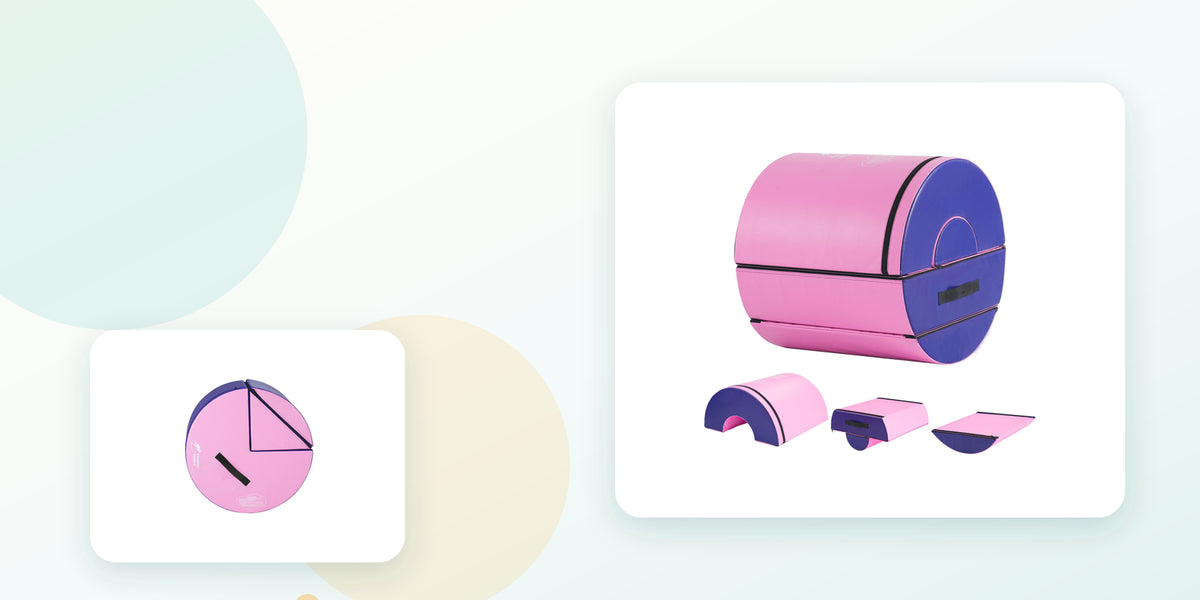
| Ages 3-10, wedge skills (forward rolls, round-offs) | Rainbow Tumbling Cheese Wedge Mat Combo | Wedge shape lowers the entry angle for forward rolls and round-offs, building skill confidence before flat-mat progression |
What Features Distinguish Kangaroo Hoppers Mats?
Every Kangaroo Hoppers mat is built with a durable waterproof PVC leather outer shell, high-resilience EPE foam filling, and integrated Velcro strips on the sides for connecting multiple mats into a longer tumbling surface.
- Foldable 4 to 5 panel design: All mats fold compactly for storage and carry two built-in handles for easy transport between rooms or to outdoor practice spaces.
- Non-toxic materials: Kangaroo Hoppers mats are crafted from odor-free, non-toxic materials tested and confirmed to contain no harmful phthalates or chemicals that would affect a child's skin or health.
- Expandable surface: Velcro strips on all sides mean a single mat can grow into a full tumbling lane as the child's skills progress, without purchasing a different product.
Browse the complete gymnastics mats collection to compare all available sizes and configurations, or view the incline gymnastics mat for kids if your child is working on forward rolls and skill-specific incline drills.
If budget is a factor, the guide on where to buy affordable tumbling mats explains what features to prioritize when choosing value-focused options.
How Do You Keep a Kids Floor Mat Clean and Safe Long-Term?
A well-maintained kids floor mat stays safe longer, and the cleaning routine matters as much as the initial material quality. Research shows floor dust is the primary route of phthalate exposure in children in play environments, which means clean mat surfaces directly reduce one measurable exposure pathway.
What Is the Right Way to Clean a Kids Floor Mat?
The correct cleaning method depends on the mat's outer material, but most foam and vinyl-covered mats share the same basic protocol.
- Daily wipe-down: Use a damp cloth with a mild child-safe cleaner after active play sessions. This prevents surface build-up that can harbor bacteria and particulates.
- Avoid harsh chemicals: Strong cleaning agents degrade foam and vinyl surfaces over time, which can compromise the mat's structural integrity and, in the case of lower-quality materials, accelerate off-gassing of any residual chemicals.
- Dry completely before folding: Folding a damp mat traps moisture between panels, which can encourage mold growth in the seams. Air-dry flat or slightly unfolded before storing.
- Inspect seams and surfaces regularly: Cracks, peeling vinyl, or compressed foam in high-use areas signal that the mat has reached the end of its protective life. Replace mats that show visible foam deterioration.
The tri-fold gymnastics mat design makes storage particularly easy and reduces the chance of moisture trapping between panels during drying.
FAQs About Kids Mats for Floor
What is the best type of floor mat for kids?
The best floor mat depends on age and activity. For infants and crawlers, a soft foam play mat at least 0.5 inches thick provides safe cushioning. For active school-age children doing gymnastics, cartwheels, or tumbling, a foldable gymnastics mat with high-density EPE foam offers greater impact protection and durability for dynamic movement.
How thick should a kids floor mat be?
For infants doing tummy time, 0.5 inches is sufficient. For toddlers over 18 months who walk, fall, and climb, aim for 20-30mm. For children ages 3-12 doing active gymnastics, cheerleading, or tumbling, a mat of 1.5 to 2 inches thick gives the best combination of impact absorption and a stable landing surface.
Are foam floor mats safe for kids?
Foam floor mats can be very safe when made from certified non-toxic materials. Look for mats that are explicitly free from phthalates, formamide, BPA, and heavy metals, and check for certifications such as CPSIA compliance and EN-71 testing. Mats made with high-density EPE or tested EVA foam and labeled non-toxic provide a reliable, healthy surface for daily play.
What certifications should I look for on a kids floor mat?
The most important certifications are CPSIA, EN-71, and ASTM F963. Look for mats explicitly labeled phthalate-free and formamide-free, not just "non-toxic" as that term is unregulated. A trusted brand will disclose which specific tests their mat has passed rather than relying on vague eco-friendly language.
How do I keep a kids floor mat clean and hygienic?
Wipe foam and vinyl-covered mats regularly with a damp cloth and a mild, child-safe cleaner. Avoid harsh chemicals that can degrade foam over time. Research shows floor dust is the primary route of phthalate exposure in children, so keeping mat surfaces clean and replacing mats showing wear or cracks significantly reduces exposure risk.
Can I connect multiple kids floor mats together?
Yes, many kids gymnastics and tumbling mats feature Velcro strips or hook-and-loop fasteners on the sides, allowing you to join multiple mats end-to-end for longer tumbling runs. Kangaroo Hoppers tumbling mats include Velcro on all sides so families can expand the play surface as children progress in skill and confidence over time.
Conclusion
The right kids mat for the floor brings together three things: the correct thickness for the child's age and activity, certified non-toxic materials backed by real third-party testing, and a setup that keeps the mat stable and edges clear of furniture hazards.
Start with age-appropriate thickness, confirm certifications before you buy, and match the mat type to your child's actual activities. Browse the tumbling mats for kids range to find the right fit, or explore the full gymnastics mat lineup for options that grow with your child.
Disclaimer
This article provides general guidance on selecting floor mats for children's play and physical activity, and is intended for informational purposes only. Parents and caregivers should assess their child's individual developmental stage, supervision needs, and home environment, and consult a qualified pediatric professional if they have specific concerns about safety or physical activity suitability.
References
1. Wang J, Xu Z, Yao J, et al. Identification of Phthalates from Artificial Products in Chinese Kindergarten Classrooms and the Implications for Preschool Children's Exposure Assessments. Int J Environ Res Public Health. 2022;19(13). https://pmc.ncbi.nlm.nih.gov/articles/PMC9265414/
2. Kim DY, Chun SH, Jung Y, et al. Phthalate Plasticizers in Children's Products and Estimation of Exposure: Importance of Migration Rate. Int J Environ Res Public Health. 2020;17(22). https://pmc.ncbi.nlm.nih.gov/articles/PMC7699231/
3. Kim HH, Yang JY, Kim SD, et al. Health risks assessment in children for phthalate exposure associated with childcare facilities and indoor playgrounds. Environ Health Toxicol. 2011;26:e2011008. https://pmc.ncbi.nlm.nih.gov/articles/PMC3214980/

Leave a comment
This site is protected by hCaptcha and the hCaptcha Privacy Policy and Terms of Service apply.