
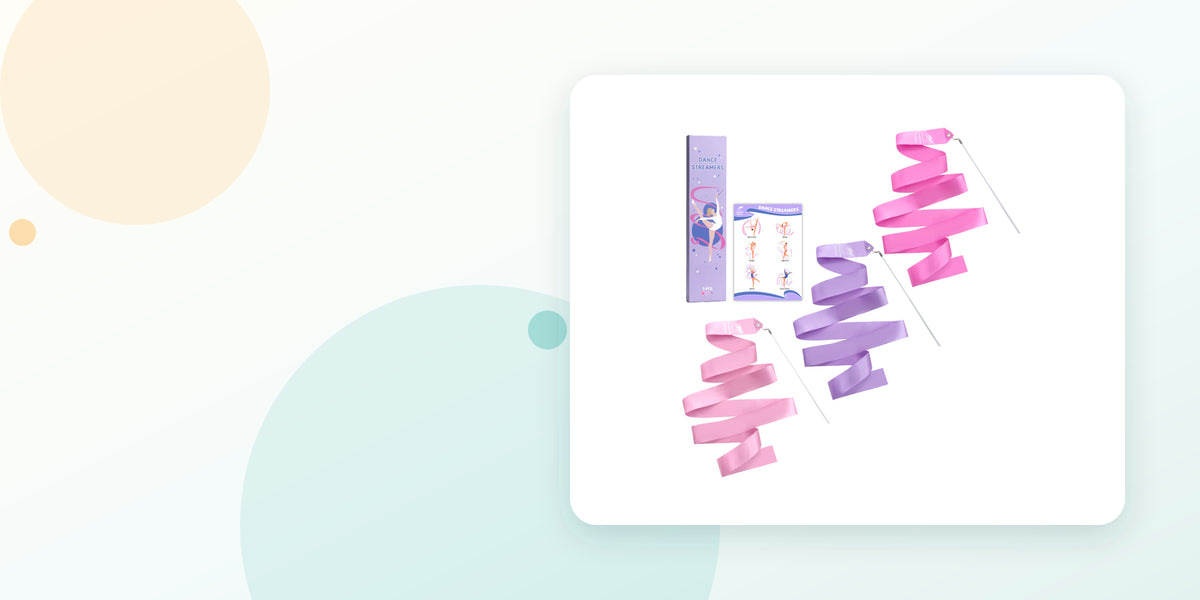
Ribbon gymnastics is one of the most magical ways for kids to explore movement, coordination, and creativity. Whether your child caught a glimpse of rhythmic gymnastics on television or simply loves twirling colorful things through the air, learning to work with a gymnastics ribbon is a skill any beginner can build at home or in a class.
This guide covers what ribbon gymnastics is, how to pick the right ribbon and stick, how to hold the stick correctly, the six foundational moves every beginner learns, and how to build a safe four-week practice routine with no prior experience.
Quick Answer: Ribbon gymnastics for beginners involves learning to move a satin or polyester ribbon attached to a short stick in flowing patterns like circles, spirals, and snakes. Kids ages 5 to 14 can start with a 3-4 meter ribbon, hold the stick in the center of the palm with the index finger extended, and practice large shoulder-driven circles before progressing to wrist-driven spirals.
Table of Contents
- What Is Ribbon Gymnastics?
- What Are the Benefits of Ribbon Gymnastics for Kids?
- How Do You Choose the Right Ribbon and Stick?
- How Do You Hold the Ribbon Stick Correctly?
- What Are the 6 Basic Ribbon Moves for Beginners?
- What Are the Most Common Mistakes Beginners Make?
- How Can Kids Practice Ribbon Gymnastics Safely at Home?
- What Does a 4-Week Beginner Practice Plan Look Like?
- What Should Kids Wear and Where Should They Practice?
Key Takeaways
- Start Small: Children ages 5 to 14 can begin ribbon gymnastics using a shorter 3-4 meter ribbon for easier control before moving to the full 6 meter competition length.
- Grip Matters First: Placing the stick end in the center of the palm with the index finger extended along the stick is the foundation of every ribbon pattern.
- Two Body Sources: Large circles and swings originate from the shoulder, while spirals and small patterns are driven from the wrist, so beginners should master each source separately.
- Flexibility Supports Skill: A study of 46 young rhythmic gymnasts found hip and shoulder flexibility was a key predictor of technical execution, making gentle daily stretching valuable from day one.
- Safe Space Counts: Practicing on a soft gymnastics mat in a clear, open area protects against slips and gives the ribbon enough room to travel without catching on furniture.
What Is Ribbon Gymnastics?
Ribbon gymnastics, formally called rhythmic gymnastics ribbon work, is a discipline in which a gymnast uses a long flowing ribbon attached to a short stick to create continuous aerial patterns set to movement or music. The ribbon is one of five official apparatuses used in rhythmic gymnastics alongside the hoop, ball, clubs, and rope, and it is widely considered both the most eye-catching and the most technically demanding for beginners to tame.
At a recreational or beginner level, ribbon gymnastics is simply about learning to keep the ribbon moving in clean shapes through space. The ribbon should never stop or lie flat on the floor, and the goal is to connect one pattern smoothly into the next.
- The ribbon: Made from satin or lightweight polyester, usually 4-6 cm wide, and between 4 meters (for young beginners) and 6 meters (competition length) long.
- The stick: A short baton, typically 50-60 cm long, made from wood, plastic, or fiberglass, with the ribbon attached at one end via a swivel or small hook.
- The patterns: Spirals, circles, snakes, figure-8s, swings, and flicks are the foundational vocabulary every beginner builds first.
- The movement source: Some patterns are driven from the shoulder (large movements), others from the wrist (tight, precise patterns), making body awareness a core skill.
For a great introduction to what ribbon gymnastics looks like in practice, explore our guide to floor gymnastics moves for beginners alongside ribbon work, as many foundational body skills overlap between the two disciplines.
What Are the Benefits of Ribbon Gymnastics for Kids?
Ribbon gymnastics builds a broad set of physical and creative skills that transfer directly to other sports and activities, making it an especially well-rounded choice for young children just beginning to explore movement. A study of 46 young rhythmic gymnasts (average age 9.9 years) found that hip and shoulder flexibility was a key predictor of technical execution scores, reinforcing why gentle flexibility work is worth prioritizing from the very beginning of training.[1]
- Coordination and bilateral skills: Keeping the ribbon alive requires the hand, wrist, arm, and shoulder to work in sequence, training the kind of complex motor coordination that supports everything from handwriting to sports.
- Flexibility and range of motion: Reaching, circling, and spiraling the ribbon through a full range of motion naturally encourages shoulder, wrist, and hip mobility over time.
- Spatial awareness: Learning where the ribbon is in space relative to the body, the floor, and nearby objects builds three-dimensional awareness that benefits children in almost every physical activity.
- Rhythmic timing and musicality: Matching ribbon patterns to music or a count develops the sense of timing and rhythm that underpins dance, team sports, and many creative arts.
- Confidence and self-expression: Because ribbon gymnastics is creative rather than purely competitive at beginner level, children of widely varying ability levels find genuine enjoyment and visible progress early on.
How Do You Choose the Right Ribbon and Stick?
Choosing the right ribbon and stick for a child beginner comes down to three things: ribbon length scaled to the child's age and arm span, a material that flows smoothly without kinking, and a stick sized so the tip does not drag on the floor when held at the child's side. Getting the sizing right from the start prevents frustration and makes every pattern easier to learn.
What Ribbon Length and Material Work Best for Children?
For children aged 5 to 10, a ribbon of around 3 to 4 meters provides enough visual flow to learn shapes without constant tangling. Older beginners and teens can move up to a 5 to 6 meter ribbon, matching the official FIG competition standard of at least 6 meters in length and 4-6 cm in width, and satin or lightweight polyester are both excellent material choices since they flow smoothly and resist kinking.
- Ages 5 to 8: A 3 meter ribbon in satin or soft polyester, brightly colored for visual feedback during practice.
- Ages 9 to 12: A 4 to 5 meter ribbon works well, giving more room for spirals and snakes while still being manageable.
- Teens (13 and up): A 5 to 6 meter ribbon approaching competition length, in any color or material the gymnast prefers.
The Kangaroo Hoppers Kids Gymnastics Ribbon Set is designed specifically for young beginners and includes a child-appropriate ribbon and stick ready to use straight from the box.
How Do You Size the Stick for Your Child?
According to the Special Olympics Rhythmic Gymnastics Quick Start Guide, a properly sized stick should reach just above the floor when the child holds it straight down at their side, meaning the tip clears the ground by a few centimeters. A stick that is too long causes the ribbon to drag, while one that is too short limits the power and reach of shoulder-driven patterns like large circles.
How Do You Hold the Ribbon Stick Correctly?
Holding the ribbon stick correctly is the single most important technical foundation in ribbon gymnastics, because every pattern flows directly from how the stick sits in the hand. Place the tip end of the stick in the center of the palm, close the fingers lightly around it, and extend the index finger along the stick pointing toward the tip, keeping a relaxed rather than tight grip.
- Step 1 - Palm position: Rest the blunt end of the stick in the center of the palm, not the fingertips. The stick should feel balanced and secure without squeezing.
- Step 2 - Index finger guide: Lay the index finger flat along the length of the stick, pointing toward the tip. This single adjustment transforms wrist control for small patterns.
- Step 3 - Loose fingers: Wrap the remaining three fingers lightly around the stick. A tense grip blocks the fluid wrist motion needed for spirals and figure-8s.
- Step 4 - Free arm position: The arm that is not holding the stick should stay in a defined, slightly curved position at all times rather than dangling loosely at the side.
- Step 5 - Practice dry: Before adding the ribbon, practice wrist circles and shoulder circles with just the stick to feel how grip affects movement range.
A common beginner habit is gripping the stick at the very end like a hammer. Shifting the grip to the center of the palm immediately improves both control and pattern size.
What Are the 6 Basic Ribbon Moves for Beginners?
The six foundational ribbon moves cover both shoulder-driven and wrist-driven patterns, giving beginners a complete vocabulary for building simple routines. According to the Special Olympics Rhythmic Gymnastics Quick Start Guide, large circles originate from the shoulder with a straight arm, while spirals and tight patterns are controlled from the wrist, so it helps to learn each movement source before mixing them.
Large Circles
Large circles are performed with the arm straight and extended from the shoulder, keeping the ribbon on a single flat plane. Practice both clockwise and counterclockwise, facing a wall at first to stay on plane.
Spirals
Spirals are tight corkscrew patterns driven entirely from the wrist, with the ribbon forming three to six visible coils. Keep the arm extended and work the wrist rapidly in small circles, keeping the ribbon off the floor.
Snakes
Snakes are side-to-side wave patterns created by moving the stick in a rapid left-right wrist motion with the arm extended horizontally. Horizontal snakes travel across the front of the body, while vertical snakes travel up and down.
Figure-8s
Figure-8s connect two vertical circles in opposite directions, passing through a crossover point in the center. Start slowly and trace the shape with the whole arm before tightening to a wrist-driven version.
Swings
Swings are large pendulum arcs performed from the shoulder with a straight arm, keeping the ribbon on plane. Alternate left and right swings to build arm strength and spatial rhythm.
Flicks and Throws
A flick is a sharp, fast wrist snap that sends the ribbon tip popping upward. Once the flick is comfortable, beginners can toss the stick briefly into the air and catch it, adding a simple throw element to their pattern vocabulary.
This follow-along video walks through basic ribbon handling patterns including circles, spirals, and directional changes, making it a useful companion to the written steps above.
What Are the Most Common Mistakes Beginners Make?
The most frequent beginner mistake in ribbon gymnastics is letting the ribbon stop moving, which causes it to fall, tangle, or pile up on the floor. Every pattern should transition smoothly into the next without a pause, because a moving ribbon is far easier to control than one that has lost momentum.
- Gripping the stick too tightly: A tight grip locks the wrist and makes spirals and figure-8s impossible to execute cleanly. Practice relaxing the hand between each repetition.
- Using only the wrist for large circles: Large circles must come from the shoulder with a straight, extended arm. Bending the elbow collapses the pattern and causes the ribbon to plane incorrectly.
- Letting the ribbon touch the floor: Ribbon patterns should stay off the floor at all times except when a specific ground move is intentional. Practice raising the arm height until the ribbon clears the floor by at least 30 cm.
- Switching hands without a smooth transfer: Changing the stick from right to left hand mid-pattern requires the ribbon to keep moving during the transfer. Practice the hand swap slowly as a standalone drill before adding it to a pattern sequence.
- Practicing only one direction: Both the Special Olympics guide and coaches consistently emphasize practicing all patterns with both the right and left hand equally, since one-sided training creates imbalances over time.
Many of these mistakes disappear naturally once a child practices the correct grip and understands which body part drives each pattern. Starting with just five minutes of circles and spirals daily builds the muscle memory that eliminates bad habits before they become ingrained.
Explore the basic gymnastics skills guide for additional foundational movement principles that overlap with ribbon work.
How Can Kids Practice Ribbon Gymnastics Safely at Home?
Kids can safely practice ribbon gymnastics at home by setting up a clear, open space with a soft floor surface, keeping sessions short and gradual in the early weeks, and focusing on large, controlled patterns before attempting complex combinations. Research on young gymnasts suggests that overuse through repetitive loading is a more common concern than acute injury at the recreational level, making pacing and variety more important than sheer volume of practice time.
"Based on her published research and clinical guidance at the AAP Council on Sports Medicine and Fitness, Dr. LaBella emphasizes that overuse injuries are the most common risk in gymnastics for young athletes, and that gradual skill progression rather than early high-volume repetition is the foundation of long-term healthy participation in gymnastics."
Cynthia R. LaBella, MD, FAAP, Medical Director, Institute for Sports Medicine, Ann and Robert H. Lurie Children's Hospital of Chicago
One two-case biomechanics study found that tiptoe balance exercises placed high calf muscle demand on a young gymnast, suggesting that beginners should minimize extended tiptoe-based movements during early practice and focus instead on flat-foot ribbon patterns.[2]
- Clear the space first: Move furniture at least 2 meters away from the practice area in all directions so the ribbon can swing and circle freely without catching on edges or corners.
- Use a soft floor surface: Practicing on a gymnastics mat or a gymnastics tumbling mat significantly reduces the risk of slipping on hard floors, especially when the child steps or turns during pattern transitions.
- Keep early sessions to 15-20 minutes: Short, focused sessions build skill faster than long, unfocused ones and reduce the repetitive stress that accumulates when a child drills one pattern many times in a row.
- Practice barefoot or in flat shoes: Bare feet or thin-soled dance shoes provide the most accurate proprioceptive feedback during early skill learning. Thick-soled athletic shoes mask the foot-floor connection that beginners need.
- Warm up the wrists and shoulders first: Gentle wrist circles, shoulder rolls, and arm swings for two to three minutes before picking up the ribbon help prepare the joints most involved in ribbon work.
What Does a 4-Week Beginner Practice Plan Look Like?
A structured four-week plan helps beginner children build ribbon skills progressively, ensuring each new move is supported by the ones learned before it. Elite rhythmic gymnasts maintain consistent technique and physical training routines even during disruption, underscoring the value of regular, structured home practice for building lasting physical literacy at any level.[3]
- Week 1 - Grip and circles: Focus entirely on correct grip technique and large shoulder-driven circles. Practice clockwise and counterclockwise on both hands, 10 repetitions each, twice daily.
- Week 2 - Swings and spirals: Add pendulum swings from the shoulder and introduce wrist-driven spirals. Alternate between circles (shoulder) and spirals (wrist) in the same session to train both movement sources.
- Week 3 - Snakes and figure-8s: Introduce horizontal snakes and slow figure-8 patterns. Combine circles, spirals, and snakes into a short 30-second flowing sequence.
- Week 4 - Full pattern sequence and flicks: Connect all five pattern types into a 60-second sequence set to music. Add the wrist flick as a finishing movement and practice the hand transfer between right and left.
Pair this progression with a set of gymnastics bundles for kids to build out the home practice space with everything needed for a full beginner setup. For children ready to expand beyond ribbon work, the adjustable gymnastics beam is a natural next progression piece.
What Should Kids Wear and Where Should They Practice?
For ribbon gymnastics practice at home, children need minimal specialized clothing, and a dedicated space does not need to be large or elaborate. A clear open area of roughly 4 meters by 4 meters is enough for most beginner ribbon patterns, with adequate height to raise the arm fully overhead without the ribbon catching on the ceiling.
- Clothing: A fitted leotard, dance top with leggings, or any close-fitting activewear that does not snag the ribbon. Avoid loose sleeves or dangling drawstrings that can catch the stick mid-pattern.
- Hair: Hair should be tied back securely in a bun or ponytail. Loose hair is the most common cause of ribbon tangles during early practice.
- Footwear: Bare feet or thin canvas dance shoes (also called half shoes) are ideal. Toe shoes aid turning once the child is ready for pirouettes.
- Floor surface: A soft gymnastics floor surface provides the best base for movement. Avoid thick rugs that catch feet during turns.
- Overhead clearance: The practice space should have enough ceiling height for the child to extend the arm and ribbon fully overhead. Most standard rooms are fine for beginner patterns.
For children who want to expand their home gymnastics setup, the gymnastics kip bar bundle and incline gymnastics mat offer natural companion equipment as skills grow. The gymnastics blocks beginner guide is also worth reading if your child is building a broader home gymnastics station.
FAQs About Ribbon Gymnastics for Beginners
What age can kids start ribbon gymnastics?
Kids can start ribbon gymnastics as young as age 5 or 6, using a shorter, lighter ribbon that suits their arm span and coordination level. Most beginner classes welcome children aged 5 to 12, making it an ideal activity for school-age kids who enjoy movement, music, and creative expression.
How long should a gymnastics ribbon be for a child?
For a beginner child aged 5 to 10, a ribbon length of around 3 to 4 meters is recommended for easy control and fewer tangles. Older beginners and teens can use a standard 5 to 6 meter ribbon, which meets competition guidelines and allows fuller spiral and circle patterns.
Can kids practice ribbon gymnastics at home?
Yes, kids can safely practice ribbon gymnastics at home with enough open space, ideally an open living room or backyard. Laying a soft gymnastics mat on the floor helps protect against slips, and clearing furniture away ensures the ribbon can swing and circle freely without catching on objects.
What are the easiest ribbon moves for beginners?
The easiest ribbon moves for beginners are large shoulder circles and simple horizontal swings, since both use big, open arm movements that are natural and easy to feel. Once circles feel smooth, children can progress to spirals from the wrist, then gentle snakes and figure-8 patterns as coordination improves.
How do you hold a gymnastics ribbon stick?
Hold the ribbon stick by placing the end of the stick in the center of the palm, wrapping fingers around it, and extending the index finger along the stick toward the tip. Keep a relaxed, light grip rather than squeezing tightly, since a tense grip restricts wrist movement and makes smooth ribbon patterns harder to create.
What kind of ribbon is best for kids gymnastics?
Satin and lightweight polyester ribbons are both good choices for kids' rhythmic gymnastics because they flow smoothly, hold shape in patterns, and resist kinking. For young beginners, a brightly colored satin ribbon around 3 to 4 meters long attached to a wooden or plastic stick is a practical and affordable starting option.
Do you need a coach to learn ribbon gymnastics?
A coach is helpful but not required to start ribbon gymnastics at a beginner level. Many kids successfully learn foundational moves like circles, spirals, and swings using follow-along video tutorials designed for young beginners, then join a recreational class once they are comfortable with basic ribbon handling and want more structured guidance.
Conclusion
Ribbon gymnastics is one of the most accessible ways for children to develop coordination, flexibility, and creative movement from the start. Choosing the right ribbon length, learning a correct grip, and clearing a safe practice space puts any child on a solid path through the six foundational patterns.
Begin with large shoulder circles in week one, add spirals and snakes in weeks two and three, and by week four most beginners can link all patterns into a short flowing sequence. Browse the gymnastics beam collection as the next step in building a complete home gymnastics space.
Disclaimer
This article is intended for general informational and educational purposes only and does not constitute professional gymnastics coaching, sports medicine advice, or medical guidance for children. Parents and guardians should consult a qualified gymnastics coach or pediatric sports medicine specialist before beginning any new physical training program, particularly if a child has existing injuries, health conditions, or developmental considerations.
References
1. Donti O, Bogdanis GC, Donti A, Apostolidis N. The relative contribution of physical fitness to the technical execution score in youth rhythmic gymnastics. J Hum Kinet. 2016;51:143-152. https://pmc.ncbi.nlm.nih.gov/articles/PMC5260563/
2. Rutkowska-Kucharska A, Szpala A. Muscle Coactivation during Stability Exercises in Rhythmic Gymnastics: A Two-Case Study. Appl Bionics Biomech. 2018;2018:8260402. https://pmc.ncbi.nlm.nih.gov/articles/PMC5902072/
3. Bobo-Arce M, Sierra-Palmeiro E. Training in Rhythmic Gymnastics During the Pandemic. Front Psychol. 2021;12:658872. https://pmc.ncbi.nlm.nih.gov/articles/PMC8062703/


Leave a comment
This site is protected by hCaptcha and the hCaptcha Privacy Policy and Terms of Service apply.