

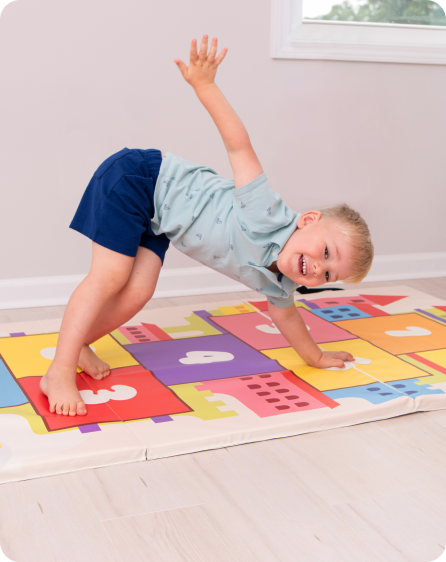
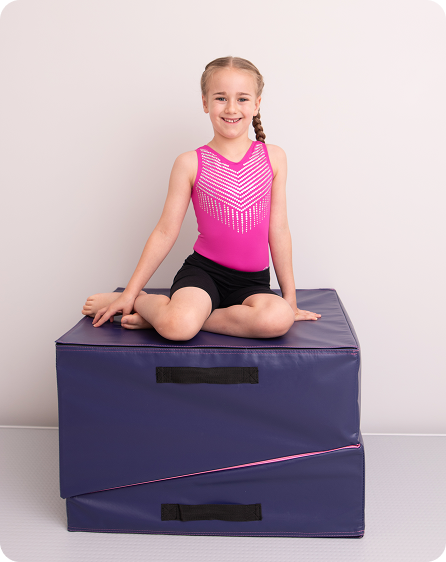
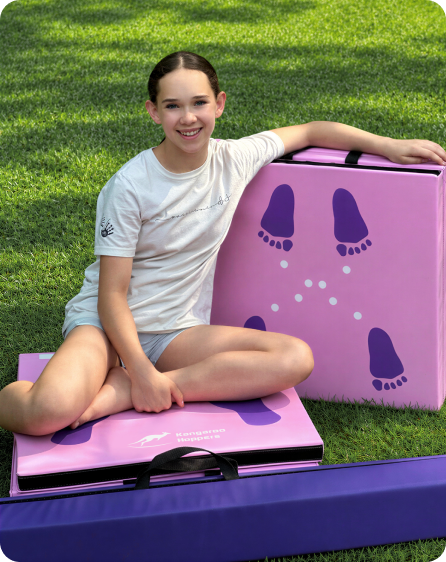
The best gymnastics mat for kids in 2026 is the one that fits your child's current skill, your floor space, and your budget, not the thickest mat on the shelf. This guide compares Kangaroo Hoppers mats by foam, thickness, size, and price so you can choose once.
It covers ages 2 to 15, from first forward rolls to supervised handspring drills, and it flags the skills that belong in a gym rather than a playroom. By the end you will know which mat to buy and how much floor to clear.
Quick Answer: For most families, the best gymnastics mat for kids is a foldable mat with 1.5 to 2 inches of firm foam, a wipe-clean cover, and at least a 3 by 6 ft surface. A tri-fold mat suits small rooms, while a wedge or octagon mat adds drills for rolls and handsprings.
Key Takeaways
- Foam first: A firm 1.5 to 2 inch foam core with a wipe-clean cover matters more than color or styling.
- Measure the floor: A 3 by 6 ft mat needs about 7 by 10 ft of clear space, so check the room before you order.
- Match the shape: Tri-fold mats suit small rooms, foldable 4 by 8 ft mats suit tumbling runs, and wedge or octagon mats add specific drills.
- Firm beats soft: A very soft mat lets small ankles roll and hides foam that has already broken down.
- Buy once: One larger mat usually costs less than two small mats plus connectors when your child starts linking skills.

What Should You Look for in a Gymnastics Mat for Kids?
A good gymnastics mat for kids has a firm foam core, a wipe-clean cover, a base that grips the floor, and enough surface for the longest skill your child practices. Foam density, thickness, and cover quality decide how the mat feels and how long it lasts, so compare those before color or price.
- Foam core: EPE foam keeps a foldable mat light, while crosslink polyethylene foam holds a firmer shape for repeated tumbling drills.
- Cover: PVC, vinyl, and PU covers all wipe clean, and reinforced stitching resists splitting along the fold.
- Base grip: A textured or non-slip base keeps the mat from sliding on hardwood, tile, or a garage floor.
- Folding system: Hook and loop edges let you join two mats into a longer run, and built-in handles make a 4 by 8 ft mat easier to move alone.
- Surface size: Buy the largest mat your room allows, because kids outgrow a small mat long before they wear it out.
Start with the gymnastics mat collection to compare current sizes and foam options. Read how to choose a gymnastics mat for home if you want the full checklist for a first setup.
How Thick Should a Kids Gymnastics Mat Be?
Most kids do well on 1.5 inches of foam for rolls, splits, and stretching, and on 2 inches for cartwheels, handstands, and tumbling drills. Thickness only helps when the foam is firm enough to support a landing without letting small feet sink.
A 2025 Scientific Reports landing study tested a certified competition mat, a carpet surface, and three custom mats built from different foam layers.[1] The certified mat produced the lowest peak force and the longest time to peak, softer mid-layers came closest to it, and stiffer builds passed more load up the leg.
Foam construction therefore changes how a mat handles impact, not only how it feels underfoot. The study measured young adult women rather than children, so treat the result as direction rather than a promise about your own child.
- Ages 2 to 4: 1.5 inches handles floor play, forward rolls, and balance games with an adult within reach.
- Ages 5 to 8: 2 inches suits cartwheels, handstands, and bridge work, where knees and elbows hit the mat hardest.
- Ages 9 and up: 2 inches of firmer crosslink foam holds up to repeated walkover and handspring drills.
If two mats give you the same thickness, choose the one with the denser core. A dense 1.5 inch mat usually supports a landing better than a soft 2 inch mat that compresses to the floor.
How Much Floor Space Does a Home Mat Setup Need?
A 3 by 6 ft mat needs about 7 by 10 ft of clear floor, and a 4 by 8 ft mat needs roughly 8 by 12 ft once you leave two feet of landing room on every side. Measure the room first, because the mat is the easy part and clear floor is what limits most homes.
- Step 1: Measure the longest open wall in the room and note door swings, radiators, and furniture you cannot move.
- Step 2: Add two feet on each side of the mat footprint, which turns a 3 by 6 ft mat into a 7 by 10 ft practice area.
- Step 3: Check ceiling height and light fixtures if your child practices handstands or uses a bar in the same space.
Storage is the other half of the space question. A tri-fold mat folds into a stack about the size of a coffee table, while a 4 by 8 ft mat folds to roughly 2 by 4 ft, so a closet or basement corner usually works.
If you are unsure whether a mat or a padded play surface fits your routine, this comparison of play mats versus tumbling mats explains where each one belongs.
Which Mat Shape Fits Your Child's Skill Level?
Match the mat shape to the skill rather than to your child's age: flat foldable mats carry tumbling runs, tri-fold mats fit small rooms, wedge mats teach rolls and back bends, and octagon mats support handspring progressions with a coach. Most families start with one flat mat and add a shaped mat when a specific skill needs it.
| Kangaroo Hoppers mat | Size and foam | Listed price | Best for |
|---|---|---|---|
| Foldable tumbling mat | 3 x 6 ft, 2 x 8 ft, 4 x 8 ft; 1.5 or 2 in EPE foam, PVC cover | 79.99 dollars for the 2 x 8 ft size | Tumbling runs, family play, shared spaces |
| Tri-fold gymnastics mat | 3 x 6 ft; 1.5 in EPE foam, vinyl cover, built-in handles | 89.99 dollars | Small rooms and daily pack-away |
| Cheese wedge mat | Sizes M and L; incline surface | 145.99 dollars | Forward rolls, back bends, confidence drills |
| Octagon trainer mat | Size M; crosslink polyethylene foam, PU anti-slip cover | 169.99 dollars | Handspring and walkover progressions with a coach |
Listed prices are the sale prices shown on kangaroohoppers.com in November 2026 and can change. Check each product page for current sizes, colors, and stock.
The foldable tumbling mat is the most flexible starting point, because hook and loop edges let you join a second mat later instead of replacing the first one. The tri-fold gymnastics mat packs into a stack you can stand against a wall, which suits apartments and bedrooms.
A cheese wedge mat adds an incline for forward rolls, back bends, and the first bridge, and the cheese mat guide for kids explains which progressions fit each size. The octagon tumbling trainer gives a curved surface for handspring and walkover drills that should stay supervised by a coach.
This unboxing shows how a rainbow tumbling mat looks and folds in a real home before you commit to a size.
Is a Softer Mat Always Safer for Kids?
No. A very soft mat can be less safe than a firm one, because deep cushioning lets ankles roll and hides foam that has already broken down. Firm support plus adult supervision does more for safety than extra thickness.
National emergency department records from 2013 to 2020 showed that 84.0 percent of gymnastics visits were children ages 6 to 15, with lower arm fractures most common from ages 6 to 10 and ankle sprains most common after age 10.[2]
- Clear the landing zone: keep two feet of empty floor around the mat so a missed landing meets foam instead of furniture.
- Test the base: wipe dust from the floor and from the mat base before practice, because dust is what lets a mat slide.
- Retire worn foam: a mat that stays compressed after you press it has lost the support that made it useful.
- Stay within reach: for kids under 6, keep an adult close enough to catch a fall rather than call out a correction.
None of this replaces coaching. Backward tumbling, handsprings, and any skill where your child cannot see the landing belong in a gym with a trained spotter.
Which Mat Size Fits Which Age?
Toddlers and preschoolers fit a 3 by 6 ft mat, grade schoolers usually need a 4 by 8 ft surface for cartwheels and handstands, and teens linking tumbling passes need a longer run built from two connected mats.
Emergency department data for 2012 to 2018 estimated 72,542 youth gymnastics injuries a year, and 61.3 percent of them were in childhood.[3] That is one reason to buy the surface your child's current skills need rather than the smallest mat that fits the closet.
- Ages 2 to 5: a 3 by 6 ft mat covers rolls, animal walks, and balance games, and it stores in a closet.
- Ages 6 to 10: a 4 by 8 ft mat gives room for a cartwheel, a handstand, and the step out that follows.
- Ages 11 and up: two connected mats create a run long enough for round off and handspring drills.
Parents of very young children should read about tumbling mats for toddlers before buying a first mat, because toddler play follows different rules. For wedge sizing, the official cheese wedge mat size guide matches each size to a skill.
Are Pricier Kids Gymnastics Mats Worth It?
Price buys foam that keeps its shape, a cover that does not split at the fold, and a surface large enough that your child does not outgrow it within a year. A 79.99 dollar foldable mat and a 169.99 dollar octagon mat do different jobs, so the cheaper mat is not automatically the better value.
Inexpensive mats usually fail at the fold and the foam rather than at the color. A split seam or a core that stays dented ends a mat's useful life early, and that is where the real cost shows up.
- Lowest cost per year: a foldable mat used for rolls, cartwheels, and stretching covers the widest range of ages.
- Small space premium: a tri-fold mat costs a little more than a flat mat of the same size because of the folding panels and handles.
- Skill specific spend: a wedge or octagon mat earns its price only when your child works on the drills it supports.
Plan for expansion instead of replacement. Two 3 by 6 ft mats plus connectors often cost more than one 4 by 8 ft mat, and joined mats can drift apart on a smooth floor during a fast pass.
What Mistakes Should Parents Avoid at Home?
Most home mat problems come from setup and supervision rather than from the mat itself. A mat that slides, sits against furniture, or gets used for skills beyond your child's level causes more trouble than thin foam does.
- Buying by color: choose foam and thickness for the skill first, then let your child pick the color.
- Skipping the floor test: set the mat down and push it with your foot before your child trusts it with a landing.
- Teaching backward skills at home: back handsprings and back tucks need a coach, a spotter, and a sprung floor.
- Leaving the mat out: a mat left on a hard floor collects dust and slides, so wipe the base or store it folded.
- Ignoring wear: replace a mat whose foam stays dented or whose cover has split along a fold.
Progression, not equipment, is what keeps a new skill safe.
"Build up to new skills gradually by practicing drills and progressions first."
Emily Sweeney, MD, Pediatric Sports Medicine Physician, Children's Hospital Colorado
FAQs About Gymnastics Mats for Kids
What thickness gymnastics mat is best for a young child?
For most young children, a 1.5 inch mat is enough for rolls and stretching, while kids ages 6 and up learning cartwheels and handstands usually do better on a 2 inch mat with a firmer foam core. Thicker is not automatically safer, because very soft foam makes balance skills harder.
What can a home gymnastics mat do that a gym floor cannot?
A home mat protects your child from a hard floor but it cannot copy a sprung gym floor, so new tumbling passes belong in a supervised class. Home mats work best for rolls, cartwheels, handstands, splits, and strength drills, and the mat must still grip the floor.
How much floor space does a kids gymnastics mat need?
A 3 by 6 ft mat needs about 7 by 10 ft of clear floor, and a 4 by 8 ft mat needs roughly 8 by 12 ft once you allow two feet of landing room on every side. Measure the longest skill your child practices before you order.
Are foam mats safe for toddlers?
Yes. Foam mats are safe for toddlers when the foam is firm enough to stand on, the cover has no tears, and an adult stays within reach the whole time. Avoid very soft play mats for tumbling, because small feet sink and ankles roll easily on deep cushioning.
How do you clean and store a kids gymnastics mat?
Wipe the vinyl or PU cover with a damp cloth and mild soap, then dry it fully before folding. Store the mat flat or folded on its seams in a dry room, away from heat, and never stack heavy boxes on the foam, which crushes the core over time.
When should you upgrade to a bigger gymnastics mat?
Upgrade when your child runs out of mat before finishing a skill, lands half off the edge, or starts linking two or more skills in a row. A 3 by 6 ft mat suits one skill, while a 4 by 8 ft mat or two connected mats suit tumbling runs.
Conclusion
The best gymnastics mat for kids in 2026 is the one your child can use safely every week: firm 1.5 to 2 inch foam, a cover that wipes clean, a base that grips, and a surface big enough for the current skill.
Measure your floor this week, choose one mat from the gymnastics tumbling mat range, and add a wedge or octagon only when a specific drill calls for it.
Disclaimer
This article covers equipment selection for home practice and does not replace medical, injury, or training advice from a qualified professional. Talk with your child's coach or a pediatric clinician before your child starts a new skill or returns to tumbling after an injury.
References
1. Brtva P, Bizovska L, Canty B, Skypala J, Irwin G, Farana R. Modifying landing mat properties elicits different lower limb biomechanical responses in gymnasts and non-gymnasts. Sci Rep. 2025;15(1):42490. doi:10.1038/s41598-025-26522-y. PMCID: PMC12660871.
2. Albright JA, Meghani O, Lemme NJ, Owens BD, Tabaddor R. Characterization of Musculoskeletal Injuries in Gymnastics Participants From 2013 to 2020. Sports Health. 2023;15(3):443-451. doi:10.1177/19417381221099005. PMCID: PMC10170233.
3. Tisano B, Zynda AJ, Ellis HB, Wilson PL. Epidemiology of Pediatric Gymnastics Injuries Reported in US Emergency Departments: Sex- and Age-Based Injury Patterns. Orthop J Sports Med. 2022;10(6):23259671221102478. doi:10.1177/23259671221102478. PMCID: PMC9201328.

Leave a comment
This site is protected by hCaptcha and the hCaptcha Privacy Policy and Terms of Service apply.